

RedAmonAI-Powered Offensive Security Platform
······ ··· ······ ······ ··· ····· ····
A parallelized recon engine maps every domain, port, endpoint, secret, and CVE into a graph database. A fireteam of autonomous AI specialists then queries that graph in real time to plan, exploit, and pivot with full battlefield awareness.
Published in full
101 / 104 on the XBOW benchmark
The 104 XBOW validation benchmarks are self-contained web targets, each hiding one flag behind a real, exploitable vulnerability. RedAmon solves 101 of them fully black-box, and publishes the complete unedited session plus a decoded walkthrough for every single solve.
97.1% solved, fully black-box
104 self-contained web targets, each hiding one flag behind a real, exploitable vulnerability. A run counts as a solve only when the agent recovers the exact flag string from the live target. RedAmon recovered it on 101 of them, handed nothing but an opaque URL.
Every solve on the scorecard links to the unedited agent session and a decoded, phase-by-phase walkthrough of the attack chain, so any row can be read end to end and re-run.
Read the full benchmarkEvery solve ships the unedited agent session plus a decoded, phase-by-phase walkthrough of the attack chain.
The agent gets one opaque http://lab-XXXXXXXX/ URL. No stack, no endpoints, no vulnerability class, no README.
~1,407 s wall time and ~0.75M tokens per solved target, cold start, with no recon pipeline run beforehand.
IDOR, SQLi, SSRF, SSTI, XXE, deserialization/RCE, path traversal, auth and business-logic bypass.
RedAmon and XBOW are independent projects. The benchmarks are used as-is except for minimal compatibility fixes required by modern Docker and by retired Debian suites, each logged in the wiki; none alters the attack surface, the win condition or the flag. This evaluation is not endorsed or certified by XBOW.
What attackers run against you, you run first.
A full offensive stack of recon engines, exploit frameworks, and AI agents, sandboxed in containers and gated by engagement phase.
One command to deploy.
Watch
A Full Tour of the Platform
See RedAmon end to end: the recon pipeline, the autonomous agent, the attack-surface graph and the automated fix-and-PR flow, all in one walkthrough.
Install in Three Commands
Self-hosted Docker stack. One script bootstraps Postgres, Neo4j, the agent, the recon containers and the webapp. No external accounts required to run a scan.
Enterprise Ready
Built for Enterprise, Secure by Design
RedAmon is engineered to drop into a real security organization, not just a researcher's laptop. Offensive software held to the standard it tests others by: STRIDE threat-modeled, fully isolated, governed and multi-tenant, and deployable to a hardened server in one command.
Secure by Design, STRIDE Threat-Modeled
Offensive software held to the standard it tests others by. The whole platform is assessed end to end under STRIDE and hardened in independently verified waves.
Code-level privilege separation, a filtering Docker broker in front of the host socket, SSRF egress guards, secret redaction, append-only audit trails, supply-chain pinning. Published Security Posture + Threat Model docs.
Fully Isolated & Containerized
Every tool, scanner and agent runs in its own container with no host-level execution. Scan jobs spawn as ephemeral sibling containers and are torn down on completion.
Per-job filesystem and network namespace, no cross-job contamination, host stays clean, and the blast radius of any exploit or misbehaving tool stays contained.
Governed & Multi-Tenant
Built for a real security team: multi-user, multi-project tenancy with admin and standard roles, and DB-level user_id + project_id scoping on every node.
Tenant-isolated Cypher, per-project LLM providers, shared key vault with rotation, and 500+ per-project settings give teams the control an enterprise engagement requires.
Rules of Engagement & Approval Gates
Upload an RoE PDF and it is parsed into structured constraints enforced at three layers. Human-in-the-loop gates guard every dangerous tool and phase transition.
Non-bypassable scope, exclusions, time windows and rate limits, plus a non-disableable hard guardrail that blocks government, military and intergovernmental targets.
Fail-Closed by Default
Unset auth tokens reject rather than serve, default database credentials are refused and rotated, and WebSockets require a signed ticket plus a same-origin check.
Every request is scoped to its authenticated owner with anti-enumeration 404s. Two deployment postures (loopback-local and hardened public) share one trust model.
One-Command Server Deploy
Beyond localhost, a hardened single-host deploy stands up a shared, internet-reachable instance and wraps the stack in the internet-facing security layer.
nginx + TLS (Let's Encrypt), host firewall, SSH hardening and fail2ban behind a single public HTTPS origin. Drives redamon.sh over SSH from your laptop with ./deploy.sh init.
Your AI Offensive Engineer
An autonomous agent that thinks, plans, and attacks like a human pentester. It chooses targets, picks tools, adapts to findings, and keeps going until the objective is reached or escalation is needed.
Agent Tool Belt
The dedicated tools the agent calls directly, each with structured I/O, timeout discipline and graph-aware routing.
- query_graphNatural-language queries over the Neo4j attack-surface graph (Domains, Subdomains, IPs, Ports, Endpoints, CVEs, Secrets, Technologies). Primary recon source.
- web_searchKB-first hybrid search (FAISS + Neo4j) over GTFOBins, LOLBAS, NVD, ExploitDB, OWASP, Nuclei templates and tool docs. Falls back to Tavily when confidence is low.
- cve_intelProjectDiscovery vulnx CLI: NVD + CISA KEV + EPSS + HackerOne + public PoC links + Nuclei template availability in one passive query.
- shodanInternet-wide OSINT: search exposed devices, fetch host details, reverse DNS, domain DNS, count without burning credits.
- google_dorkPassive Google search via SerpAPI with site:, inurl:, intitle:, filetype:, intext: operators.
- execute_nuclei8000+ YAML templates for CVE verification and exploitation. Custom templates served from /opt/nuclei-templates.
- execute_curlHTTP requests for reachability, headers, status codes, banners and baseline diffing.
- execute_httpxFast HTTP prober with status, title, server, redirect chain and technology detection in JSONL output.
- execute_naabuFast TCP/SYN port scanning to verify open ports or scan targets not yet in the graph.
- execute_nmapDeep scanning with version detection, OS fingerprint and the full NSE script library.
- execute_subfinderPassive subdomain enumeration via certificate transparency, DNS datasets and search engines. No traffic to target.
- execute_amassOWASP Amass subdomain discovery with passive, active, brute-force and ASN intel modes.
- execute_gauPassive URL discovery from Wayback Machine, Common Crawl, AlienVault OTX and URLScan.
- execute_katanaJS-aware web crawler that finds endpoints, paths and known files (robots.txt, sitemap.xml).
- execute_jsluiceStatic analysis of downloaded JavaScript for hidden API endpoints, parameters and embedded secrets.
- execute_arjunBrute-forces ~25,000 parameter names to surface hidden GET, POST, JSON and XML params before injection testing.
- execute_ffufFast web fuzzer for directory, virtual host and parameter discovery with SecLists wordlists.
- execute_wpscanWordPress scanner for vulnerable plugins, themes, users and config backups.
- execute_hydraTHC Hydra brute-force across 50+ protocols (SSH, FTP, RDP, SMB, MySQL, PostgreSQL, HTTP forms, Tomcat, WordPress).
- metasploit_consolePersistent msfconsole singleton with module context and live Meterpreter sessions across calls.
- msf_restartFull Metasploit reset: kills every active session and clears module config. Takes 60-120s.
- execute_playwrightReal-browser automation for SPAs, dynamic pages, form filling, XSS dialog proof and multi-step flows.
- execute_codeRun multi-line Python, bash, ruby, perl, C or C++ exploit scripts without shell escaping. 120s timeout.
- tradecraft_lookupAuto-fetch curated security URLs (HackTricks, PayloadsAllTheThings, custom user library) and embed them into reasoning steps.
- proxy_brainThe agent's Burp Suite, but written in code instead of clicked in a UI. It gets the whole recorded history of the target's traffic and writes its own small programs to dig through it, resend requests, tamper with them, and see how the site reacts. It can read pages, replay and fuzz requests, work with tokens, and even drive a real browser to catch the bugs that only show up after the page's JavaScript runs. Anything that actually touches the target is locked to that one host, kept inside its own project, and only allowed once the attack phase begins. Replaces the old set of ten separate proxy tools.
- kali_shellGeneral bash -c gateway to the full Kali toolset. See the catalog below for everything reachable from here.
kali_shell catalog
Single bash -c gateway to the full Kali toolset, wordlists, Python libraries and pre-staged post-exploit binaries.
Fireteam Parallel Specialists
Deploy N specialist sub-agents investigating independent attack angles concurrently. Each runs its own ReAct loop and approval queue.
Scatter-Gather ReAct pattern: asyncio fan-out, fan-in to unified context, no recursion, per-agent attribution.
EvoGraph Attack Chain Evolution
Every tool, finding, exploit and dead-end persists as a queryable graph that survives across sessions. New sessions auto-load prior context.
5-node attack taxonomy, dual-layer in-memory + async Neo4j writes, cross-session learning at session init.
Wave Runner Parallel Tools
When the agent spots independent tools, it runs them all at once under a single Wave card and merges their analysis.
asyncio batched tool execution, single streaming card, joint output reasoning, slashing wall-clock time by N.
Auto-Classify, Auto-Route Skills
The agent classifies every finding against the active skill registry and routes it to the matching built-in or user-defined attack skill without manual selection.
LLM tags each finding with the closest registered skill slug; phase gate, ROE check, and payload defaults are looked up automatically from the skill's manifest.
Deep Think Strategic Reasoning
At session start, phase transitions and 3+ failure loops the agent pauses for structured Situation / Vectors / Approach / Priority / Risks analysis.
Four trigger conditions, five-section output, injected into all subsequent reasoning. Counts as roughly 1 extra LLM call per engagement.
Stateful Meterpreter Sessions
Keep post-exploit shells open and run lateral movement, privilege escalation and exfil interactively, not as one-shot payloads.
Stateful + stateless modes, persistent session state, 70+ post-exploit commands, Meterpreter-aware routing.
NAT-Transparent Reverse Shells
Auto-tunnel reverse shells over ngrok or Chisel. LHOST and LPORT are auto-discovered and payloads are pre-configured for the agent.
Two providers (ngrok TCP single-port, Chisel multi-port bidirectional), auto-started inside Kali sandbox, hidden endpoint config.
TrafficMind HTTP Capture
A credential-free mitmproxy man-in-the-middle sits between every tool and its target, recording the full request/response of each HTTP transaction, tagged by project, run and tool. An HTTP history that turns on with a toggle, and an agent that hunts across it in code.
Every request and response that flows between a tool and its target is quietly recorded, and each one is scanned as it passes for the small tells of a weak spot: values echoed straight back, missing security headers, loose cookies. Sitting on top of that history is proxy_brain, the agent's Burp Suite written in code. Instead of clicking through a fixed set of buttons, the agent writes its own short programs to explore the site, resend and tamper with requests, work with login tokens, and drive a real browser to catch the bugs that only appear once the page's JavaScript has run. That matters because most real vulnerabilities are a recipe, not a single click: ask the same question in a loop, pull a secret out one character at a time, chain one weakness into the next. Code can express that; a fixed menu of buttons can't. It all runs in a locked-down sandbox with no direct access to the database, only the safe read-and-replay channels the agent is given. Anything that actually hits the target is tied to that one host, kept inside its own project, and allowed only once the attack phase begins.
10-Layer Safety Guardrails
Multi-level scope enforcement: LLM ethics gate, 250+ hard-coded .gov / .mil / critical-infra blocklist, RoE parser, stealth mode, phase gating, HITL approvals, tenant-isolated Cypher, sandboxed Kali container.
Soft LLM guardrail, deterministic regex blocklist, three-tier RoE enforcement, stealth-mode tool restrictions, phase-gated tool map, 27-tool confirmation list, phase-transition approval, per-skill OOB toggles, read-only Cypher with user_id+project_id filters, containerized execution.
Bounded Approval Workflow
Human-in-the-loop gates on Metasploit, Hydra, code execution and phase transitions. Flip a switch for fully autonomous mode.
Per-project Agent Behaviour, deterministic dangerous-tool list, stealth mode disables noisy tools and blocks live scanning.
Live Guidance Steering
Type a message while the agent is mid-engagement and it gets injected into the next reasoning step. Refocus, redirect or veto without stopping the session.
Examples: 'focus on SSH vulnerabilities', 'skip the web app, look at network services', 'try a different exploit module'. Acknowledged by the agent before the next think iteration.
Parallel Pentest Sessions
Run multiple independent agentic conversations per project, each with its own phase, todo list and execution trace. Switch between them without losing state.
Per-conversation checkpointing, days-later resume, agent-running indicators, auto-generated titles, Markdown export. Stop and Resume preserve full context.
Offline Security Knowledge Base
Local FAISS + Neo4j RAG index over curated security datasets (GTFOBins, LOLBAS, NVD, ExploitDB, OWASP, Nuclei, MITRE) queried before any external web search.
6-stage pipeline: hybrid retrieval, source boosts, cross-encoder rerank, MMR diversity, sufficiency check. ~250 ms vs 1-3 s Tavily, works offline, falls back automatically when confidence is low.
Natural Language → Cypher
Ask the agent “show endpoints with injectable params” and it generates the Cypher query, with 3-attempt error recovery.
25+ example patterns, automatic parameter binding, write ops blocked, tenant-filtered to prevent cross-project leakage.
Tradecraft Lookup
Curate trusted hacking sources (HackTricks, PayloadsAllTheThings). The agent fetches and cites pages mid-attack.
Per-user URL library, auto-fetch during chains, content embedded into reasoning steps with source attribution.
400+ LLM Models, 12 Providers
Swap the agent brain across OpenAI, Anthropic, OpenRouter, Google Gemini, DeepSeek, GLM, Kimi, Qwen, xAI Grok, Mistral, AWS Bedrock and any OpenAI-compatible endpoint, per project or per session.
Model-tuned system prompts, hot-swap, dynamic model fetching, OpenAI-compatible bucket covers Ollama, vLLM, LM Studio, Groq, Together AI, Fireworks AI, Deepinfra.
Built-in Agent Skills
Phase-aware workflows for CVE/MSF, SQLi, XSS, SSRF, RCE, Path Traversal/LFI/RFI, Hydra brute force, phishing simulation and availability testing. Auto-selected by the Intent Router from a single user message.
Per-skill tool routing (sqlmap, dalfox, commix, sstimap, ysoserial, hydra, msfvenom, slowhttptest), OWASP 4-stage rigor, OOB oracles via interactsh, RoE-gated activation.
User Agent Skills
Drop-in Markdown attack workflows from the community: XXE, BFLA, IDOR/BOLA, SSTI, insecure deserialization, mass assignment, subdomain takeover, insecure file uploads, advanced API/SQLi/XSS exploitation.
Each skill is a single .md file with phased steps and a description for classification, injected verbatim across all three phases. Upload your own from Global Settings, toggled per project.
Chat Skills
Reference library for tool flags, vulnerability theory and framework quirks. Inject any of them mid-conversation with /skill ffuf, /skill nextjs, /skill jwt, etc.
Categories cover Active Directory, Cloud, Post-Exploitation, Tooling, Protocols, API Security, Technologies, Frameworks, Vulnerabilities. Persist across messages, swap on demand, no impact on classification.
Agent Workspace
An interactive working environment with three editors sharing the same files: you through the live drawer, the agent through 24 filesystem tools, and the Kali terminal inside the sandbox. The agent uses it to draft payload lists, take scratchpad notes between phases, run scans in the background, and consolidate findings into reports that survive every turn of the engagement. The agent writes, you watch, the next prompt picks up where the last one left off.
read · write · edit (with undo) · grep · glob · find · tree · symbols · hash · diff · archive · extract
spawn long scans as detached async tasks · run 4+ in parallel · fs_grep their logs mid-flight
outputs over 20 KB land in tool-outputs/ with a head/tail stub · context never bloats
UI drawer + agent tool calls + Kali terminal · same files, instantly synced
One Agent, Twelve Brains
Hot-swap the model that drives the agent — per project, per session, mid-engagement. Frontier APIs, Chinese open-weights, your own local Ollama box. Tilt a card, click through to grab a key.
OpenAI
Frontier reasoning
Anthropic
Tool-use champion
OpenRouter
200+ aggregated
Google Gemini
Long context
DeepSeek
Cheap + open
GLM (Zhipu)
Multilingual
Kimi (Moonshot)
200k context
Qwen (Alibaba)
Open-source reasoning
xAI Grok
Real-time web
Mistral AI
European open-weight
AWS Bedrock
Enterprise foundation
OpenAI-Compatible
Ollama · vLLM · Groq
400+ models · dynamic fetching · OpenAI-compatible bucket covers Ollama, vLLM, LM Studio, Groq, Together AI, Fireworks AI, Deepinfra
MCP Server · Inbound
Plug Your Own Agent Into RedAmon
RedAmon is also an MCP server. Mint a token, paste one config line, and the agent you already use drives the whole platform: 30 tools behind 9 permissions you tick yourself. It acts as you, inside your own projects, and you can revoke it mid-sentence.
Clients that load skill files get a generated onboarding pack, tailored to one of 14 agent profiles, that teaches yours what RedAmon is and which tool to reach for first. Every other client gets the same guidance inline the moment it connects.
Read the attack surface
Ask the graph in plain English, or send your own read-only Cypher.
list_projectsgraph_summarygraph_schemaquery_graphget_attack_surface_overviewlist_graph_viewsrun_graph_viewWork the findings
Every finding, the exploit paths, the blast radius, and a verdict that sticks.
list_findingslist_muted_findingslist_remediationslist_exploit_pathsget_blast_radiusset_finding_verdictRun and watch scans
Start, stop or queue a recon run, then diff it against the last one.
start_reconstop_reconqueue_reconcancel_queued_scanget_recon_statusget_scan_statusget_project_activitylist_scan_versionscompare_scan_versionsTune it, or open a shell
126 documented settings, 26 presets, and the Kali sandbox if you unlock it.
get_recon_settingsdescribe_recon_settingsupdate_recon_settingslist_recon_presetskali_toolboxkali_execkali_outputkali_cancelFrom Terminal Chaos to Knowledge Graph
Drag the slider. On the left: the way pentest data lives without RedAmon — JSONL files, scrollback buffers, scattered notes. On the right: the same engagement, normalized into a Neo4j attack-surface graph the agent reasons over.
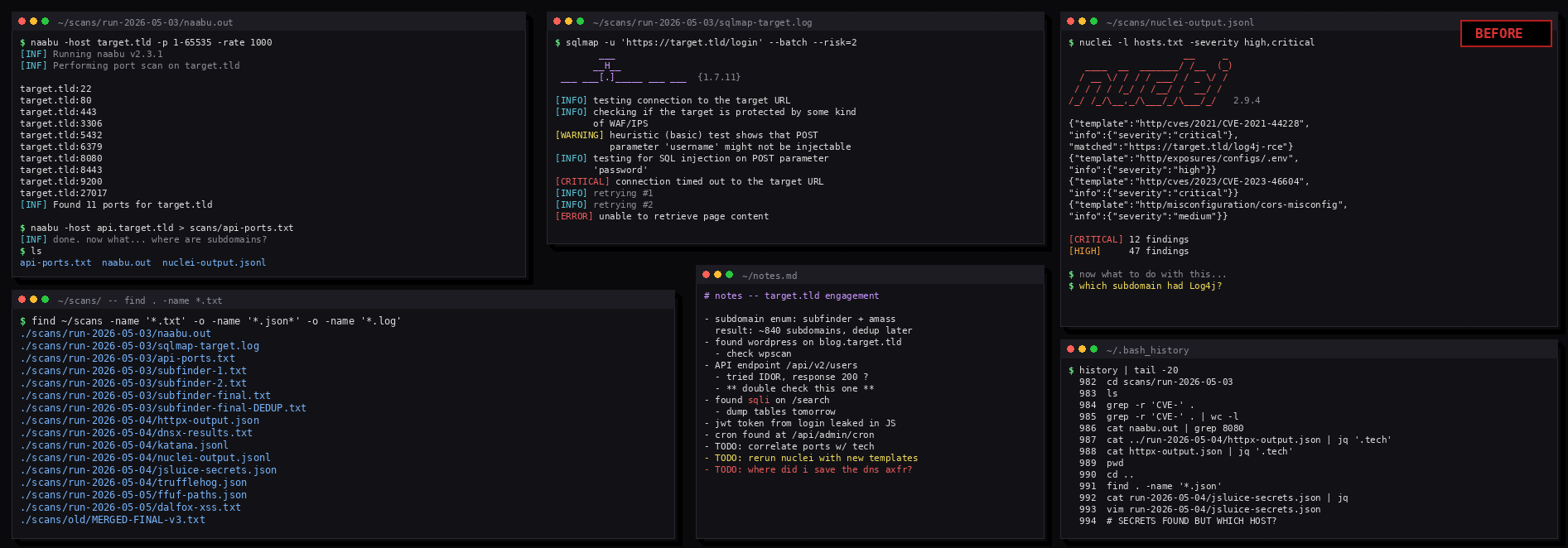
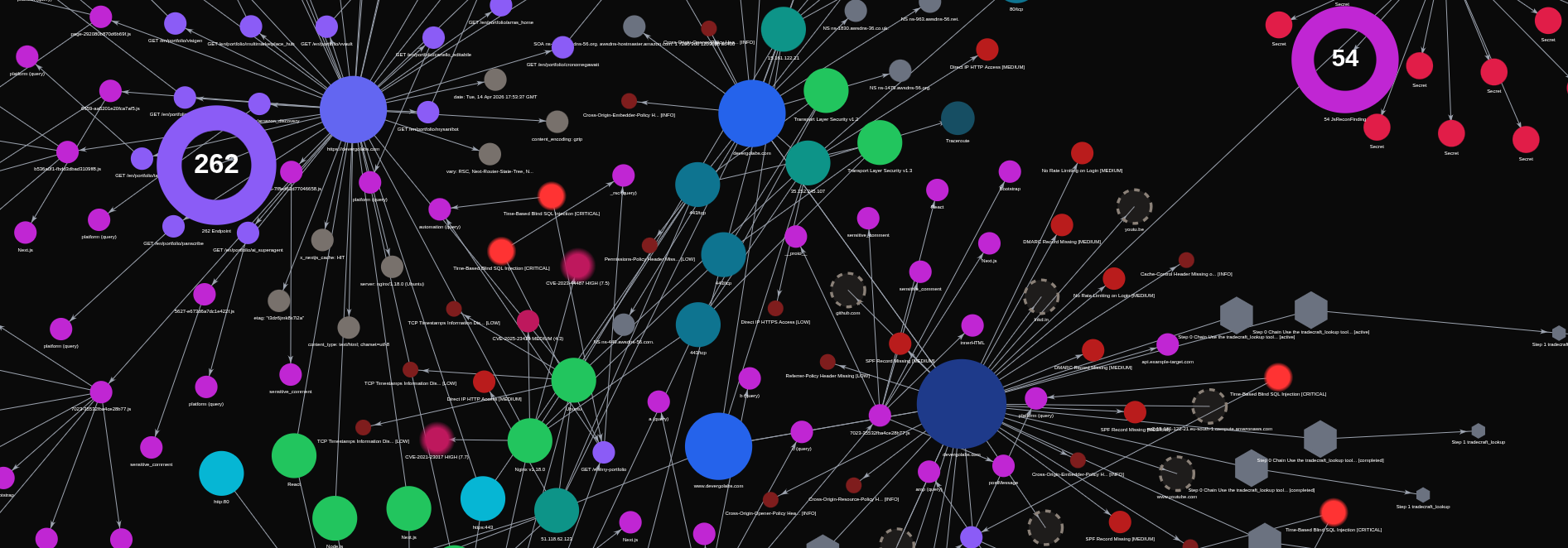
Drag the divider · same data · two ways of living with it
Recon as a Living Knowledge Graph
Industry-standard scanners chained so each tool's output feeds the next, then merged into a single Neo4j knowledge graph. Findings are deduplicated, relationships are explicit, and the agent inherits a structured, fully connected attack surface ready to query in natural language.
Recon Pipeline Modules
Each module is an independent stage of the deterministic recon engine. Findings flow downstream as graph nodes and relationships, ready for the agent to query.
Tool Output → Agent Knowledge
The modules are not isolated scanners. Each tool's output is the next tool's input: subdomains feed port scans, ports feed HTTP probes, URLs feed crawlers, JS bundles feed secret detectors. Every finding lands in the graph as a node, every dependency as a relationship.
Producer / consumer mapping locks every stage to the next, MERGE-based writes deduplicate across runs, and the resulting graph becomes the structured knowledge the agent reasons over via query_graph and Cypher.
21 Parallel Recon Modules
Independent modules running concurrently end-to-end: subdomain discovery, OSINT enrichment, port scanning, TLS certificate grabbing, HTTP probing, web crawling, JS analysis, AI surface fingerprinting, GraphQL testing, vhost discovery, takeover detection, web cache poisoning, origin-IP discovery, vulnerability scanning, secret hunting and security configuration checks.
ThreadPoolExecutor fan-out, MERGE-based graph writes, RoE-aware tool gating, partial recon to re-run any single tool without redoing the pipeline.
80+ Tools, Libraries and Sources
Battle-tested CLI tools, APIs and detector libraries shipped across the modules: Subfinder, Amass, Nuclei, Httpx, Naabu, Masscan, Nmap, Katana, FFuf, jsluice, GVM, Subjack, BadDNS, vulnx and 60+ more.
Full ProjectDiscovery suite, OWASP Amass, OpenVAS NVT corpus, vulnx + NVD + KEV + EPSS + MITRE ATT&CK / CWE / CAPEC, 7 passive OSINT sources, 90+ JS secret patterns, 1060 Secret Multiscanner detectors across 14 source kinds, 40+ takeover provider fingerprints.
32-Node Attack Surface Graph
Every recon stage feeds a single Neo4j knowledge graph the agent reasons over: Domain → Subdomain → IP → Port → Service → CVE → Endpoint → Vuln.
32 node types, 50+ relationships, multi-tenant scoped (user_id + project_id on every node), EvoGraph bridges to attack chains.
JS Deep Reconnaissance
Extract API endpoints, cloud keys, JWT secrets, source maps and dependency confusion vectors from JavaScript bundles.
jsluice + 90+ regex patterns (AWS, GCP, Stripe, Twilio), framework fingerprinting, graph-indexed for agent reuse.
Every Tool Fully Configurable
Each module exposes its full parameter surface in the project settings UI: thread counts, rate limits, scan profiles, wordlists, severity filters, custom flags. UI fields become the tool's CLI arguments at scan time.
169+ project settings across dedicated per-tool forms, sensible defaults, validated input, immutable post-apply for reproducible scans, free-form custom-args field for power users.
170k+ NVT Network Vuln Scanning
Real network-level GVM/OpenVAS scans against live IPs (not just DAST) with QoD scoring and CVSS-rated findings.
Parallel container, configurable scan profiles (Full+fast, Full+slow), CVE/Vulnerability node feeds linked to IP/Port/Service.
Secret Multiscanner: 14 Sources, 1060 Detectors
Hunt live credentials across git, GitHub (incl. deleted commits), GitLab, Docker registries, Hugging Face, S3, GCS, filesystem, Jenkins, Elasticsearch, Postman, CircleCI and Travis CI — then live-verify each secret against the owning service's API.
1060 detectors, one hardened container per source (isolated network, read-only root, non-root, single credential) so sources scan in parallel, a validation_status per finding, results stored as MultiscannerScan → Repository / Image / Model / Bucket / Endpoint → MultiscannerFinding nodes.
GitHub Secret Hunter
Mine GitHub search, repos and commit history for hardcoded credentials with 40+ entropy-validated patterns.
Public + private repos, full commit history, PDCP-compatible, results merged into the graph as Secret nodes.
VHost & SNI Hidden Host Discovery
Find admin panels, staging sites and k8s ingress backends hidden behind reverse proxies via L7 Host + L4 SNI probing.
Per IP×subdomain pair, separate BaseURL nodes, detection method tagged, exposes Cloudflare routing inconsistencies.
21 Recon Presets + AI-Generated
One-click profiles for API, web, internal, cloud or IoT. Or ask the AI to generate a custom preset for your target.
328+ pipeline parameters, immutable post-apply for reproducible scans, AI generation via LLM on demand.
Workflow View + Chain-Break Detection
Visual 11-stage pipeline diagram with animated edges and amber/red warnings when tool dependencies are starved.
Three-band layout (data / tools / data), click-through tool config modal, Tab/Workflow toggle, real-time edge animation.
Partial Recon Single-Tool Runner
Re-run any tool (Nuclei, Naabu, Katana) on custom inputs without redoing the full pipeline. Results MERGE into the graph with no duplicates.
Per-tool play button, custom-targets modal, MERGE logic with orphan UserInput cleanup, saved tool settings honoured.
AI in Pipeline
AI layered over the deterministic recon boosts and tunes every tool execution against the live response fingerprint, dropping wasted probes and sharpening coverage on modern targets.
Optional per-tool hooks, master toggle in Target tab, fail-safe fallback to static config on any LLM error.
Software Supply Chain
Catch Malicious & Vulnerable Dependencies
Three layers over one offline OSV engine: audit an uploaded SBOM or a GitHub repo, harvest the packages a live target actually serves, or let the agent verdict a package mid-engagement. Every layer merges into the same Package and MalPackageFinding graph nodes, and never runs npm / pip install on a target manifest.
Three Layers, One Engine
Detect known-malicious (MAL-) and known-vulnerable (CVE / GHSA) packages across a target's whole dependency surface, verdicted fully offline against a local OSV mirror.
OSV-Scanner as the zero-network verdict engine, GuardDog for opt-in behavioural analysis, retire.js for black-box JS harvest. A repo scan, an SBOM upload and a live harvest all dedup onto the same Package and MalPackageFinding graph nodes.
L1: SBOM & GitHub Audit
Upload any SBOM or lockfile (CycloneDX / SPDX, package-lock.json, yarn.lock, go.sum) or point it at a GitHub repo, public or private. No live target required.
Launched from the Red Zone Other Scans modal, anchored to an SbomDocument or GithubRepository node, shallow-cloned in an isolated sandbox, streamed live, exported as raw JSON.
L2 Live Harvest + L3 Agent Tools
Against a live target with no manifest, the pipeline harvests the packages the site actually serves and verdicts them offline. Mid-engagement, the agent calls OSV / GuardDog on demand.
L2 mines source-maps, imports, tech→purl and retire.js from JS recon already downloaded (zero new requests), anchored to BaseURL. L3 exposes execute_osv_scanner and execute_guarddog as agent tools.
Offensive AI Testing
Run the AI Through a Gauntlet of Attacks
Recon finds the AI surface; the AI Gauntlet breaks it. It runs every LLM endpoint you discovered through four industry red-team tools, scores how often each attack works, and writes the proof back onto the graph, all graded by a local model with zero external egress.
Four Red-Team Tools, One Verdict
garak, PyRIT, Giskard and promptfoo attack every LLM endpoint recon found, then agree on a single answer: which attacks land, how often, and how badly.
Each tool runs isolated, grades against the OWASP LLM Top 10, and emits a normalized finding, so results from four very different engines line up side by side.
garak: 40 Probe Families
A broad single-shot sweep: prompt injection, DAN jailbreaks, encoding bypass, data-leak replay, system-prompt extraction, toxicity, malware generation and package hallucination.
Every family is fired repeatedly and scored as an attack-success rate; a family that errors on one target never aborts the run.
PyRIT: Multi-Turn Jailbreaks
Bounded conversations that escalate turn by turn (crescendo, skeleton-key, tree-of-attacks and many-shot) to break models that refuse a single bad prompt but cave under pressure.
A local attacker / judge model drives and scores each conversation; max-turns and a fixed seed keep every run reproducible.
Giskard + promptfoo: Tailored & Corroborated
Giskard generates app-specific tests from a description of your target (injection, info disclosure, hallucination, bias, sycophancy); promptfoo runs public attack datasets as an independent second opinion.
A weakness confirmed by more than one tool is flagged as corroborated, the strongest kind of finding.
Findings Land on the Graph
Each confirmed weakness becomes a Vulnerability node linked to the endpoint it broke, mapped to OWASP LLM / MITRE ATLAS, with an attack-success rate, trial count and a saved transcript as proof.
They surface in the Red Zone AI Gauntlet Vulnerabilities table and the pentest report; re-running a tool updates the finding instead of duplicating it.
Zero-Egress, RoE-Gated
The model that grades the answers runs locally, so prompts, responses and proof never leave your machine. Probe a sensitive target without leaking a single token.
Off by default, blocked until you confirm authorization, with the worst categories hard-blocked and every run bounded by trials, turns and timeouts.
CypherFix Closes the Vulnerability Loop
Two specialized AI agents pick up where reconnaissance and exploitation leave off. The triage agent reads the graph, dedupes findings across scanners, prioritizes by exploitability and proposes ranked remediation. The CodeFix agent then implements those fixes against your real repository and ships them as a pull request.
From Recon to Pull Request
Nine steps from a blank scope to a merged pull request. The recon pipeline collects findings deterministically. The agent attacks autonomously. The platform auto-writes the report. CypherFix patches the code. All in the same loop.
Recon
Full Recon Pipeline
Twenty modules run in parallel and chain producer-to-consumer: subdomain discovery, OSINT enrichment, port scanning, HTTP probing, web crawling, JS deep recon, AI surface fingerprinting, GraphQL testing, vhost discovery, takeover detection, web cache poisoning, origin-IP discovery, vulnerability scanning, secret hunting and security configuration checks.
Knowledge Graph
Every finding lands as a typed Neo4j node and every dependency as an explicit edge. Findings are deduplicated across scanners on the way in. The graph becomes the structured memory the AI agent reasons over with Cypher and natural language.
Engagement
Set the Goal
Tell the agent in plain English what you want pwned. The Intent Router classifies the request, picks the right attack skill, and the agent plans its own todo list. Rules of Engagement and approval gates keep everything inside scope.
Exploitation
A fireteam of specialist sub-agents attacks in parallel: CVE / Metasploit, SQLi, XSS, SSRF, RCE, Path Traversal, Hydra brute force, phishing simulation. Each runs its own ReAct loop with full graph awareness and tool autonomy.
Post-Exploitation
Stateful Meterpreter sessions, lateral movement, privilege escalation, persistence and exfiltration. NAT-transparent reverse shells over ngrok or Chisel auto-tunnel from the Kali sandbox so the operator never has to expose ports.
Closing the Loop
Pentest Report
A six-section HTML report writes itself from the graph: executive summary, scope, risk overview, findings with CVSS / CVE / CWE / CAPEC attribution, attack surface map and remediation recommendations. Self-contained, client-ready, prints cleanly to PDF.
AI Triage
Hundreds of findings get deduplicated across scanners, prioritized by EPSS, KEV and CVSS, and turned into a ranked remediation plan. Cross-specialist convergence attribution shows which fireteam member found what.
CodeFix Agent
A second autonomous agent clones your repository, navigates the codebase with eleven code-aware tools (read, grep, edit, bash, github_*), implements the targeted fix and writes a clean diff with rationale.
GitHub Pull Request
A complete pull request lands on your repo with the fix, the diff, the rationale and the linked vulnerability ID. Review, request changes, or merge — the loop closes the moment the PR is approved.
Everything Else in the Box
Beyond the agent and the recon engine: governance, surface slicing, dashboards, training labs, knowledge base, reports, exports and multi-tenancy. The full toolkit a security team needs around an autonomous pentester.
Surface Shaper
Describe an attack surface in plain English (“CVEs CVSS>9 affecting our stack”). AI generates a read-only Cypher slice and saves named surfaces.
20 example queries, scopes both agent + canvas, infrastructure / vulnerability / web-app / threat-intel categories, reusable across sessions.
RoE Parsing & 3-Layer Enforcement
Upload a Rules-of-Engagement PDF. AI parses it into structured constraints, enforced at agent prompt + tool executor + pipeline filter.
Three-layer enforcement, deterministic hard gate, scope / exclusions / time windows / rate limits / compliance frameworks; non-bypassable by prompt injection.
Red Zone 2D / 3D Graph Canvas
Explore your full attack surface on a force-directed 2D or WebGL 3D graph, with real-time updates during scans and a click-through node drawer.
Node coloring per type, filter + legend, live properties drawer, pan/zoom/rotate, agent + scan toolbar controls.
16 Data Table Views
Switch from graph to table mode and slice the findings by type: Node Inspector, All Nodes, JS Recon, plus 13 dedicated finding tables (Vulnerabilities, CVEs, Subdomains, Endpoints, Secrets, Certificates, Ports, Services, Headers and more). Search, sort and export every one.
16 presets (3 base + 13 finding tables), per-table search and refresh, XLSX / JSON / Markdown export buttons on every preset, Node Inspector for property-level node drill-down.
HackLab: 48 Autonomous Scenarios
Proof your agent can actually pwn things: 48 scenarios across SQLi, NoSQL, RCE, XXE, SSRF, JWT, IDOR, prototype pollution.
Decoded walkthroughs, video demos, community submissions welcome, 12 categories on a deliberately vulnerable DVWS-Node + CVE lab.
Insights Dashboard Risk Analytics
Single-pane KPIs: 6-axis security radar, composite risk score 0 to 100, trend charts across the whole instance.
12 weighted signals (CVSS, EPSS, KEV, CAPEC, GVM, secrets), log-normalized radar prevents saturation, real-time aggregation.
CVE Intel Exploitability Engine
Query CVEs by CVSS≥8, EPSS≥0.5, KEV status and Nuclei template availability via Lucene syntax, with no manual KEV lookups.
vulnx CLI wrapper across NVD + KEV + EPSS + HackerOne + GitHub PoCs + Nuclei + CPE; 69 searchable fields, 6h refresh.
Offline Knowledge Base + Web Fallback
Agent queries a local KB (GTFOBins, LOLBAS, NVD, ExploitDB, OWASP, Nuclei) first. Web search runs only when KB confidence is low.
FAISS vector index + Neo4j fulltext, ≥0.35 confidence skips Tavily, works zero-API-key for sensitive engagements.
Browser-Based Kali Terminal
Full interactive xterm.js shell into the Kali sandbox container, with all 70+ pentesting tools pre-installed and no SSH needed.
WebSocket PTY (port 8016), signal handling, color support, agent proxy → kali-sandbox terminal server → /bin/bash.
Pentest Report Templates
Export findings as templated PDF / DOCX / HTML reports with executive summary, severity filters and embedded graph visualizations.
Multiple templates (executive, technical, compliance), auto-TOC, tool-output appendices, raw Cypher logs.
Data Export & Import
16 export presets covering Node Inspector, all nodes, JS Recon and 13 finding tables, in XLSX, JSON or Markdown.
Styled headers, per-column filters preserved, hyperlinks, full-project or per-table; programmatic JSON for downstream tools.
Multi-Tenant Project Management
Multi-user / multi-project tenancy with admin & standard roles, 169+ project settings and global API key rotation.
DB-level user_id + project_id filtering, per-project LLM provider, key rotation for rate-limit management, shared key vault.
See It In Action
Real RedAmon engagements recorded end to end. The agent picks targets, runs tools, adapts to findings and pwns the target while you watch. Unscripted, full timeline, no edits.
FAQ
Questions, Answered
The things people ask before they clone the repo. Everything RedAmon does is open source and self-hosted.
What is RedAmon?+
RedAmon is an open-source, autonomous AI penetration testing platform. It runs a parallelized reconnaissance pipeline across 20+ industry-standard scanners, merges every finding into a Neo4j attack-surface graph, and lets a multi-agent AI system query that graph to plan and execute exploitation from an isolated Kali Linux sandbox.
Is RedAmon free and open source?+
Yes. RedAmon is released under the MIT license, free for both commercial and personal use, and the full source code is on GitHub at github.com/samugit83/redamon.
Do I need an OpenAI account or API keys to use RedAmon?+
No external account is required to run a scan. RedAmon supports 12 LLM providers and 400+ models, including local models through Ollama, vLLM and LM Studio, so it can drive the agent entirely with self-hosted models. Cloud providers such as OpenAI, Anthropic and Google Gemini are optional and configured per project or per session.
Can RedAmon run fully offline?+
Yes. RedAmon is self-hosted as a Docker Compose stack and can run air-gapped: the agent brain can be a local Ollama model, the knowledge base is a local FAISS and Neo4j index, and the AI Gauntlet grades its results with a local model with zero external egress.
How is RedAmon different from a vulnerability scanner like Nessus?+
A traditional scanner runs a fixed set of checks and emits a report. RedAmon keeps a persistent, queryable model of the attack surface and reasons over it: findings from every tool land in one graph, an autonomous agent decides what to run next based on what it has already learned, and CypherFix closes the loop by implementing fixes and opening a pull request.
What tools does RedAmon include?+
The recon pipeline chains 80+ tools and sources including Subfinder, Amass, Nmap, Naabu, Httpx, Katana, Nuclei, FFuf and GVM. The agent additionally drives a full Kali Linux toolset through a sandboxed shell, plus Metasploit, Hydra, WPScan and more, gated by engagement phase.
What do I need to run RedAmon?+
A Linux host with Docker. Installation is a self-hosted Docker Compose stack that one script bootstraps; you clone the repository and run ./redamon.sh install.
Is it legal to use RedAmon?+
RedAmon is for authorized security testing only: engagements you have written permission to run, infrastructure you own, CTF competitions and training labs. Running it against systems you are not authorized to test is illegal in most jurisdictions.