
Chat Skills
Chat Skills are on-demand reference documents you inject into the AI agent's context during a live pentest session using the /skill command or the skill picker button. Unlike Agent Skills (which drive classification, phase routing, and tool selection end-to-end), Chat Skills are tactical -- tool playbooks, vulnerability theory, framework-specific notes -- that give the agent instant expertise exactly when you need it.
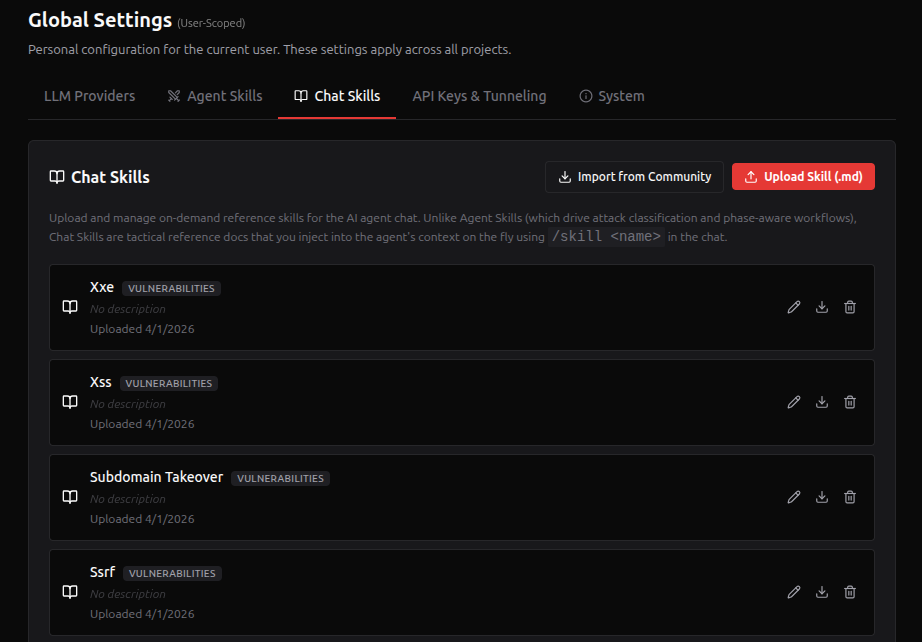
Table of Contents
- Agent Skills vs Chat Skills
- Managing Chat Skills
- Using Chat Skills in the Agent Chat
- Writing a Chat Skill File
- Default Chat Skills Library
- Community Chat Skills
- Complete Skill System Comparison
Agent Skills vs Chat Skills
RedAmon has two distinct skill systems designed for different purposes. Understanding the difference is key to getting the best results from the agent.
| Agent Skills | Chat Skills | |
|---|---|---|
| What they are | Attack workflows with phase-structured steps | Reference docs with tactical knowledge |
| How activated | Automatically -- the Intent Router classifies your request and selects the best matching skill | Manually -- you type /skill <name> or click the skill picker in the chat |
| Phase aware | Yes -- different prompts for informational, exploitation, and post-exploitation phases | No -- the full document is injected as-is regardless of phase |
| Affects classification | Yes -- skills compete as classification candidates; the agent picks the best match | No -- classification is unaware of Chat Skills |
| Tool routing | Yes -- each skill enables/disables specific tools (sqlmap, hydra, metasploit, etc.) | No -- no impact on tool availability |
| RoE integration | Yes -- skills are excluded when Rules of Engagement forbid them | No -- always available regardless of RoE |
| Persistence | Active for the entire session (all iterations of the think loop) | Active until you change or remove it |
| Token cost | Efficient -- only the classified skill is injected | Efficient -- only injected when you activate it |
| Best for | Complete attack methodologies: "Here is exactly how to exploit XSS step by step" | Quick reference: "Here is how ffuf flags work" or "Here are SSRF test vectors" |
Rule of thumb: If your skill defines a step-by-step attack procedure with phases, upload it as an Agent Skill. If it is a reference doc, cheat sheet, or conceptual guide, upload it as a Chat Skill.
For full details on Agent Skills (built-in and user), see Agent Skills.
Managing Chat Skills
Chat Skills are managed from Global Settings (gear icon in the top bar) under the Chat Skills tab.
Import from Community
RedAmon currently ships with 1 reference skill (AD Kill Chain). More Chat Skills will be added over time, and community pull requests are welcome. To add the shipped skill to your library:
- Navigate to Global Settings > Chat Skills
- Click Import from Community
- A confirmation dialog shows how many skills will be imported
- Skills with the same name as existing ones are automatically skipped (no duplicates)
The library starts empty -- click Import from Community to populate it.
Uploading Custom Chat Skills
- Navigate to Global Settings > Chat Skills
- Click Upload Skill (.md)
- Select your Markdown file
- Enter a name, optional description, and select a category from the dropdown (general, vulnerabilities, tooling, scan_modes, frameworks, technologies, protocols, coordination)
- Click Upload
The skill is immediately available via /skill <name> in all your sessions.
Editing and Deleting Skills
Each skill card in the Chat Skills tab shows:
- Skill name and category badge
- Description (or "No description" placeholder)
- Upload date
Actions:
- Pencil icon -- edit the skill's description
- Download -- download the
.mdfile - Trash icon -- delete the skill from your library
Using Chat Skills in the Agent Chat
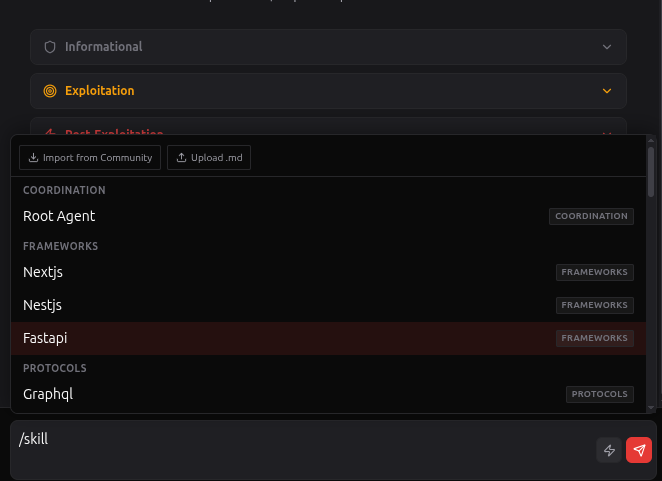
The /skill Command
Type /skill followed by the skill name in the chat input:
/skill ssrf
/skill ffuf
/skill nuclei
The skill activates immediately. A badge appears above the input showing the active skill name and category.
You can also combine a skill activation with your message in a single command:
/skill ssrf test for SSRF on the API endpoints
This activates the SSRF skill AND sends "test for SSRF on the API endpoints" as your message -- the agent receives both the skill context and your question together.
Other /skill commands:
| Command | What it does |
|---|---|
/skill <name> | Activate a skill by name (partial matching, case-insensitive) |
/skill <name> <message> | Activate skill AND send message in one shot |
/skill list | Show all available Chat Skills grouped by category |
/skill remove | Deactivate the current active skill |
The Skill Picker Button
Click the lightning bolt button (next to the send button) to open a dropdown showing all your Chat Skills grouped by category. Click any skill to activate it instantly.
The dropdown also includes two action buttons at the top:
- Import from Community -- bulk-import the shipped reference skills (same as in Global Settings)
- Upload .md -- upload a new skill file directly from the chat (no need to go to Settings)
Inline Skill Activation
You can type /skill anywhere in your message -- not just at the beginning. The autocomplete dropdown will appear as soon as you type /s:
test for /skill ssrf on the login endpoint
When you select a skill from the dropdown, the /skill ssrf part is removed from the text and replaced by the skill activation. Your message becomes:
test for on the login endpoint
With the SSRF skill badge now active above the input.
Active Skill Badge
When a skill is active, a small badge appears above the chat input:
[lightning bolt] SSRF Testing Guide vulnerabilities [X]
This badge tells you:
- Which skill is currently active
- Its category
- Click the X to remove it
The active skill persists across messages -- once activated, the skill context is included with every message you send until you change or remove it.
Removing the Active Skill
Three ways to remove the active skill:
- Type
/skill removein the chat - Click the X button on the active skill badge
- Activate a different skill (replaces the current one)
Writing a Chat Skill File
Chat Skill files are simpler than Agent Skill files. They do not need phase-structured workflows or classification keywords. Write clear, actionable reference content:
---
name: ffuf
description: ffuf fuzzing syntax with matcher/filter strategy and non-interactive defaults.
---

# ffuf CLI Playbook

Canonical syntax:
ffuf -w <wordlist> -u <url_with_FUZZ> [flags]

High-signal flags:
- -u <url> target URL containing FUZZ
- -w <wordlist> wordlist input
- -mc <codes> match status codes
- -ac auto-calibration
- -noninteractive disable interactive console mode

Agent-safe baseline:
ffuf -w wordlist.txt -u https://target.tld/FUZZ -mc 200,301,302,403 -ac -t 20 -noninteractive

Common patterns:
- Basic path fuzzing: ffuf -w wordlist.txt -u https://target.tld/FUZZ -mc 200,301,403 -ac
- Vhost fuzzing: ffuf -w vhosts.txt -u https://target.tld -H 'Host: FUZZ.target.tld' -fs 0
Key differences from Agent Skill files:
- No phase structure needed (no "Phase 1: Reconnaissance", "Phase 2: Exploitation")
- No classification keywords needed (no "When to Classify Here" section)
- Optional YAML frontmatter with
nameanddescription - Focus on reference material: flags, patterns, examples, test vectors
Default Chat Skills Library
These skills ship with RedAmon and can be loaded via the Import from Community button in Global Settings > Chat Skills or directly from the skill picker in the chat.
Active Directory (4 skills)
| Skill | /skill command | Description |
|---|---|---|
| AD Kill Chain | /skill ad_kill_chain | End-to-end Active Directory kill chain from zero-credential LAN access to DCSync / Golden Ticket; BloodHound-driven path selection via NetworkX |
| Kerberoasting + ASREPRoast | /skill kerberoasting | SPN enumeration, TGS extraction, ASREP without preauth, hashcat / john modes (18200 / 13100 / 19600 / 19700), tiered cracking strategy |
| AD-CS ESC | /skill ad_cs_esc | ESC1-ESC15 lookup table, certipy command matrix, NTLM relay to ICPR, Certifried (CVE-2022-26923), Golden Certificate |
| BloodHound Path-to-DA | /skill bloodhound | bhgraph (NetworkX) load / own / path-to-da, edge-walk recipes per BloodHound edge type, saturation strategy |
Cloud (3 skills)
| Skill | /skill command | Description |
|---|---|---|
| AWS Pentesting | /skill aws | IAM-role abuse, IMDSv1/v2 escape, S3 anonymous, Lambda env-var leaks, Cognito misconfig, SSM, SSRF-to-cloud chains |
| Azure Pentesting | /skill azure | Tenant enum, token forging, Managed Identity abuse, Logic Apps, illicit consent grant, nOAuth |
| GCP Pentesting | /skill gcp | Service-account theft, IAM role-chain, GCS public bucket, metadata server, Cloud Functions, Workspace DWD |
Post-Exploitation (3 skills)
| Skill | /skill command | Description |
|---|---|---|
| Docker Escape | /skill docker_escape | docker.sock abuse, CAP_SYS_ADMIN, hostPath, privileged container, kernel CVEs (CVE-2024-21626 leaky-vessels, CVE-2022-0847 Dirty Pipe) |
| Linux Privesc | /skill linux_privesc | Enumerate-then-abuse via linpeas / LinEnum / pspy64, GTFOBins-driven sudo / SUID / capabilities, kernel CVEs |
| Windows Privesc | /skill windows_privesc | Token impersonation (Potato variants), AlwaysInstallElevated, unquoted services, DLL hijacking, LOLBAS, kernel CVEs |
Tooling (9 skills)
| Skill | /skill command | Description |
|---|---|---|
| ffuf playbook | /skill ffuf | Path / vhost / parameter / POST-body fuzzing reference with non-interactive defaults and matcher/filter strategy |
| httpx playbook | /skill httpx | Live-host probing, scheme handling, technology detection, response storage, JSONL output |
| katana playbook | /skill katana | Crawler depth / JS-aware crawling, headless mode, known-files mode, proxy-instrumented runs |
| naabu playbook | /skill naabu | Port scanning: connect vs SYN modes, rate controls, verification, proxy support |
| nmap playbook | /skill nmap | Two-pass nmap workflow with NSE enrichment, timing templates, sandbox-friendly scoping |
| nuclei playbook | /skill nuclei | Bounded template-driven scanning, severity filtering, OAST controls, JSONL output |
| semgrep playbook | /skill semgrep | Source-aware static analysis with rule-pack selection and a black-box bridge for operator-supplied repos |
| sqlmap playbook | /skill sqlmap | Non-interactive scans, technique selection, tamper chains, bounded enumeration / dumping |
| subfinder playbook | /skill subfinder | Passive subdomain enumeration with source selection, recursion, rate limits, JSONL output |
Protocols (4 skills)
| Skill | /skill command | Description |
|---|---|---|
| GraphQL Security | /skill graphql | Introspection, alias-batched IDOR, resolver auth gaps, federation entity probes, persisted-query abuse, complexity DoS |
| WebSocket Security | /skill websocket | CSWSH, per-message auth, token-in-URL leak, subprotocol abuse, frame fragmentation, STOMP / MQTT / SignalR / socket.io |
| SOAP WS-Security | /skill soap | WSDL discovery, XML Signature Wrapping, Binary Security Token injection, UsernameToken brute, WS-Addressing, WS-Trust |
| SAML Attacks | /skill saml | XSW (8 variants), Comment Injection, Golden SAML, replay across SPs, RelayState abuse, audience confusion, algorithm downgrade |
API Security (1 skill)
| Skill | /skill command | Description |
|---|---|---|
| OpenAPI Swagger Exposure | /skill openapi | Spec discovery paths, hidden / deprecated / internal operations, server-URL env leaks, parameter-shape mining, Nuclei OpenAPI input |
Technologies (2 skills)
| Skill | /skill command | Description |
|---|---|---|
| Firebase Firestore | /skill firebase | Security Rules, Cloud Storage, Cloud Functions, ID-token validation, App Check bypass |
| Supabase | /skill supabase | Row Level Security, PostgREST filters, RPC SECURITY DEFINER, Storage policies, Realtime channels, Edge Functions |
Frameworks (3 skills)
| Skill | /skill command | Description |
|---|---|---|
| Next.js | /skill nextjs | Middleware bypass (CVE-2025-29927-class), Server Actions, RSC cache leaks, image-optimizer SSRF, NextAuth flows |
| FastAPI | /skill fastapi | OpenAPI mining, dependency-injection auth gaps, Pydantic validation bypass, CORS / proxy header trust, Jinja SSTI |
| NestJS | /skill nestjs | Swagger mining, guard bypasses, ValidationPipe gaps, multi-transport auth (HTTP/WS/microservice), serializer leaks |
Vulnerabilities (17 skills)
| Skill | /skill command | Description |
|---|---|---|
| JWT Attacks | /skill jwt | JWT/JWS forgery, algorithm confusion, header-driven key abuse (kid/jku/x5u/jwk), claim manipulation, token confusion |
| OAuth 2.0 / OIDC | /skill oauth | OAuth/OIDC flow attacks: redirect-URI abuse, PKCE downgrades, state/nonce gaps, mix-up, nOAuth, refresh-token replay |
| Open Redirect | /skill open_redirect | Allowlist evasion, parser differentials, OAuth code interception, server-side fetcher chaining, multi-hop bypass |
| Information Disclosure | /skill information_disclosure | DVCS / backups, debug endpoints, source maps, observability leaks, CDN cache differentials, triage rubric |
| CSRF | /skill csrf | SameSite nuance, token-strength patterns, content-type / method bypasses, JSON-as-form, GraphQL / WebSocket CSRF |
| Race Conditions | /skill race_conditions | Single-packet attack, HTTP/2 last-byte sync, idempotency-key abuse, distributed-lock escape, end-to-end probes |
| Business Logic Flaws | /skill business_logic | Invariant modeling, state-machine probing, refund / coupon / quota abuse, multi-tenant bleed, saga / idempotency gaps |
| LDAP Injection | /skill ldap | RFC 4515 filter abuse, blind boolean / time probes, AD attribute enumeration, DN injection, extensible-match tricks |
| XPath Injection | /skill xpath | Auth bypass, blind boolean extraction, XPath 2.0+ doc() / unparsed-text() OOB exfil, XQuery write primitives |
| Web Cache Poisoning | /skill web_cache_poisoning | Unkeyed-header probes, fat-GET, parameter cloaking, cache deception via path confusion, CDN-specific quirks |
| Prototype Pollution | /skill prototype_pollution | Client + server Node.js gadgets, lodash / jQuery / mongoose CVE landscape, RCE via shell / NODE_OPTIONS pollution |
| CORS Misconfigurations | /skill cors | Origin reflection, null-origin, wildcard-suffix abuse, ACAC + ACAO bypass classes, CSWSH adjacency |
| Host Header Injection | /skill host_header | Reset poisoning, virtual-host bypass, X-Forwarded-Host trust, JWT iss poisoning, cache-key abuse |
| Clickjacking | /skill clickjacking | XFO / CSP frame-ancestors strictness, drag-drop tricks, double-clickjacking, OAuth consent hijack |
| CRLF Injection | /skill crlf | Header injection, cookie smuggling, log forging, redirect smuggling, parser-differential probes |
| ReDoS | /skill redos | Catastrophic-backtracking patterns, language risk matrix, payload construction, timing oracles |
| 2FA OTP Bypass | /skill 2fa | Rate-limit gaps, replay, response manipulation, session-state downgrades, recovery-flow chains, MFA fatigue |
More skills coming. New reference skills will be added over time, and community contributions are welcome -- open a Pull Request with your
.mdunderagentic/skills/<category>/and it can ship with the next release. See Share Your Chat Skills with the Community for the full contribution flow.
Community Chat Skills
A growing collection of ready-to-use Chat Skill reference files contributed by the community. Each one is a reference doc you can upload via Global Settings > Chat Skills and inject on demand with /skill <name>.
| Skill | Category | Focus |
|---|---|---|
| AD Kill Chain | Active Directory | Zero-credential LAN → DCSync / Golden Ticket; BloodHound-driven NetworkX path selection |
| ffuf playbook | Tooling | Path / vhost / parameter / POST-body fuzzing reference; non-interactive defaults; matcher/filter strategy |
| httpx playbook | Tooling | Live-host probing, scheme handling, technology detection, response storage, JSONL output |
| katana playbook | Tooling | Crawler depth / JS-aware crawling, headless mode, known-files mode, proxy-instrumented runs |
| naabu playbook | Tooling | Port scanning: connect vs SYN modes, rate controls, verification, proxy support |
| nmap playbook | Tooling | Two-pass nmap workflow with NSE enrichment, timing templates, sandbox-friendly scoping |
| nuclei playbook | Tooling | Bounded template-driven scanning, severity filtering, OAST controls, JSONL output |
| sqlmap playbook | Tooling | Non-interactive scans, technique selection, tamper chains, bounded enumeration / dumping |
| subfinder playbook | Tooling | Passive subdomain enumeration with source selection, recursion, rate limits, JSONL output |
| JWT Attacks | Vulnerabilities | JWT/JWS forgery, algorithm confusion, header-driven key abuse (kid/jku/x5u/jwk), claim manipulation, token confusion |
| OAuth 2.0 / OIDC | Vulnerabilities | OAuth/OIDC flow attacks: redirect-URI abuse, PKCE downgrades, state/nonce gaps, mix-up, nOAuth, refresh-token replay |
| semgrep playbook | Tooling | Source-aware static analysis with rule-pack selection and a black-box bridge for operator-supplied repos |
| GraphQL Security | Protocols | Introspection, alias-batched IDOR, resolver auth gaps, federation entity probes, persisted-query abuse, complexity DoS |
| Firebase Firestore | Technologies | Security Rules, Cloud Storage, Cloud Functions, ID-token validation, App Check bypass |
| Supabase | Technologies | Row Level Security, PostgREST filters, RPC SECURITY DEFINER, Storage policies, Realtime channels, Edge Functions |
| Next.js | Frameworks | Middleware bypass, Server Actions, RSC cache leaks, image-optimizer SSRF, NextAuth flows |
| FastAPI | Frameworks | OpenAPI mining, dependency-injection auth gaps, Pydantic validation bypass, CORS / proxy header trust, Jinja SSTI |
| NestJS | Frameworks | Swagger mining, guard bypasses, ValidationPipe gaps, multi-transport auth, serializer leaks |
| Open Redirect | Vulnerabilities | Allowlist evasion, parser differentials, OAuth code interception, server-side fetcher chaining, multi-hop bypass |
| Information Disclosure | Vulnerabilities | DVCS / backups, debug endpoints, source maps, observability leaks, CDN cache differentials, triage rubric |
| CSRF | Vulnerabilities | SameSite nuance, token-strength patterns, content-type / method bypasses, JSON-as-form, GraphQL / WebSocket CSRF |
| Race Conditions | Vulnerabilities | Single-packet attack, HTTP/2 last-byte sync, idempotency-key abuse, distributed-lock escape |
| Business Logic Flaws | Vulnerabilities | Invariant modeling, state-machine probing, refund / coupon / quota abuse, multi-tenant bleed, saga / idempotency gaps |
| LDAP Injection | Vulnerabilities | RFC 4515 filter abuse, blind boolean / time probes, AD attribute enumeration, DN injection |
| XPath Injection | Vulnerabilities | Auth bypass, blind boolean extraction, XPath 2.0+ OOB exfil, XQuery write primitives |
| Web Cache Poisoning | Vulnerabilities | Unkeyed-header probes, fat-GET, parameter cloaking, cache deception via path confusion |
| Prototype Pollution | Vulnerabilities | Client + server Node.js gadgets, library CVE landscape, RCE via shell / NODE_OPTIONS pollution |
| CORS Misconfigurations | Vulnerabilities | Origin reflection, null-origin, wildcard-suffix abuse, CSWSH adjacency |
| Host Header Injection | Vulnerabilities | Reset poisoning, virtual-host bypass, X-Forwarded-Host trust, JWT iss poisoning |
| Clickjacking | Vulnerabilities | XFO / CSP frame-ancestors strictness, drag-drop tricks, double-clickjacking, OAuth consent hijack |
| CRLF Injection | Vulnerabilities | Header injection, cookie smuggling, log forging, redirect smuggling, parser-differential probes |
| ReDoS | Vulnerabilities | Catastrophic-backtracking patterns, language risk matrix, payload construction, timing oracles |
| 2FA OTP Bypass | Vulnerabilities | Rate-limit gaps, replay, response manipulation, session-state downgrades, recovery chains, MFA fatigue |
| WebSocket Security | Protocols | CSWSH, per-message auth, token-in-URL leak, subprotocol abuse, frame fragmentation, STOMP / MQTT / SignalR |
| SOAP WS-Security | Protocols | WSDL discovery, XML Signature Wrapping, BST injection, UsernameToken brute, WS-Addressing |
| SAML Attacks | Protocols | XSW (8 variants), Comment Injection, Golden SAML, replay, RelayState, audience confusion |
| OpenAPI Swagger Exposure | API Security | Spec discovery paths, hidden / deprecated operations, server-URL env leaks, parameter-shape mining |
| Kerberoasting + ASREPRoast | Active Directory | SPN enumeration, TGS extraction, ASREP without preauth, hashcat / john modes, tiered cracking strategy |
| AD-CS ESC | Active Directory | ESC1-ESC15 lookup, certipy matrix, NTLM relay to ICPR, Certifried, Golden Certificate |
| BloodHound Path-to-DA | Active Directory | bhgraph load / own / path-to-da, edge-walk recipes per BloodHound edge type, saturation strategy |
| AWS Pentesting | Cloud | IAM-role abuse, IMDS escape, S3 anonymous, Lambda env-var leaks, Cognito, SSRF-to-cloud chains |
| Azure Pentesting | Cloud | Tenant enum, token forging, Managed Identity, Logic Apps, illicit consent grant, nOAuth |
| GCP Pentesting | Cloud | Service-account theft, IAM role-chain, GCS, metadata server, Cloud Functions, Workspace DWD |
| Docker Escape | Post-Exploitation | docker.sock, CAP_SYS_ADMIN, hostPath, privileged container, kernel CVEs (leaky-vessels, Dirty Pipe) |
| Linux Privesc | Post-Exploitation | linpeas / LinEnum / pspy64, GTFOBins-driven sudo / SUID / capabilities, kernel CVEs |
| Windows Privesc | Post-Exploitation | Token impersonation (Potato), AlwaysInstallElevated, unquoted services, DLL hijack, LOLBAS, kernel CVEs |
More reference skills will land here over time. The catalog is intentionally small so every shipped skill is battle-tested. If you have a reference doc (tool playbook, vulnerability theory, framework notes) that has proven useful in your own engagements, please open a PR -- see below.
How to use: Click the skill above, download the .md file, then go to Global Settings > Chat Skills and upload it. Or simply click Import from Community in the Chat Skills tab (or from the skill picker in the chat) to import the shipped skills.
How Chat Skills differ from Community Agent Skills: The Community Agent Skills section lists phase-aware attack workflows (step-by-step procedures the agent follows end-to-end). Community Chat Skills listed here are reference docs -- tool guides, vulnerability theory, framework notes -- designed for on-demand injection, not classification-driven workflows.
See Agent Skills > Community Skills for workflow-style community contributions.
Share Your Chat Skills with the Community
Built a useful reference doc? Share it!
How to contribute:
- Create your
.mdfile following the Writing a Chat Skill File format - Test it in your RedAmon instance by uploading it via Global Settings > Chat Skills
- Fork the repo and add your
.mdfile toagentic/skills/<category>/ - Open a Pull Request with a short description
Complete Skill System Comparison
RedAmon has three types of skills. This table compares all three across every dimension:
| Aspect | Built-in Agent Skills | User Agent Skills | Chat Skills |
|---|---|---|---|
| Count | 6 fixed (CVE, SQLi, XSS, Brute Force, Phishing, DoS) | Up to 20 per user | Up to 50 per user + 1 default |
| Storage | Python code + prompt templates | Postgres (UserAttackSkill table) | Postgres (UserChatSkill table) + .md files on disk |
| Creation | Developer adds code | User uploads .md via Global Settings > Agent Skills | User uploads .md via Global Settings > Chat Skills, or imports defaults |
| Activation | Always active (toggled per project) | Toggled per project in Agent Skills tab | On demand via /skill <name> or skill picker in chat |
| Classification | Yes -- classifier picks skill as attack_path_type | Yes -- classifier picks as user_skill:<id> | No -- classifier is unaware |
| Phase-aware | Yes -- different prompts per phase (informational / exploitation / post-exploitation) | Yes -- same pipeline via _resolve_user_skill() | No -- full content injected as-is regardless of phase |
| Tool routing | Yes -- each skill enables/disables specific tools | Partial -- uses generic exploitation tools | No -- no tool impact |
| RoE awareness | Yes -- excluded when RoE forbids them (e.g. DoS blocked if ROE_ALLOW_DOS=false) | Inherited (classification respects RoE) | No -- always available |
| Persistence | Entire session (all think loop iterations) | Entire session | Until changed or removed by the user |
| Token cost | Efficient (only classified skill injected) | Efficient (only classified skill injected) | Efficient (only injected when user activates) |
| Content type | Multi-template (tools + payloads + workflow + verification steps) | Free-form attack workflow with phase steps | Reference doc (flags, theory, test vectors, patterns) |
| Best for | Core attack methodologies with deep tool integration | Custom attack procedures the agent follows step by step | Quick reference, tool syntax, vulnerability guides, framework notes |
| Injection point | get_phase_tools() in prompts/__init__.py -- inside the ReAct system prompt | Same pipeline -- _resolve_user_skill() | Guidance queue via WebSocket (SKILL_INJECT) or prepended to query text |
| Settings key | ATTACK_SKILL_CONFIG.builtIn | ATTACK_SKILL_CONFIG.user + USER_ATTACK_SKILLS | N/A (user-scoped, on demand) |
| Prisma model | attack_skill_config (JSON field on Project) | UserAttackSkill table | UserChatSkill table |
| Where managed | Project Settings > Agent Skills | Global Settings > Agent Skills | Global Settings > Chat Skills |
| Community folder | N/A | agentic/community-skills/ | agentic/skills/ |
| Workflow example | Phase 1: Identify injection surfaces. Phase 2: Run sqlmap with configured level/risk. Phase 3: Extract data, attempt OS shell. | User-written phases and steps tailored to a specific technique | Here are the ffuf flags, here is the syntax, here are common patterns |
When to use which
| Scenario | Use |
|---|---|
| "Test for XSS on this web app" | Agent Skill -- the agent needs a full workflow with phases |
| "What ffuf flags should I use for vhost fuzzing?" | Chat Skill -- quick reference for tool syntax |
| "Exploit SSRF to access cloud metadata" | Agent Skill -- step-by-step exploitation workflow |
| "The target uses Next.js, load the framework guide" | Chat Skill -- framework-specific knowledge |
| "Run a deep scan on this target" | Chat Skill -- scan mode reference |
| "Try SQL injection on the login form" | Agent Skill -- built-in SQLi workflow handles this |
| "I need to test for race conditions" | Upload as Agent Skill if you have a full workflow; use Chat Skill for quick theory reference |
Next Steps
- Agent Skills -- full guide to built-in and user attack workflows
- AI Agent Guide -- the AI agent chat interface, phases, and tools
- Global Settings -- configure LLM providers, API keys, and skills
- Anatomy of a Think Step -- the full anatomy of the agent's system prompt (where injected reference content lands) and the decision JSON it returns