
Running Reconnaissance
The reconnaissance pipeline is RedAmon's core scanning engine — a fully automated, parallelized process that maps your target's entire attack surface using a fan-out / fan-in architecture. Independent modules run concurrently via ThreadPoolExecutor, while data-dependent steps run sequentially. This page explains how to launch a scan, monitor its progress, and understand the results.
Before You Start
Make sure you have:
- A user selected (see User Management)
- A project created with a target domain, IP/CIDR targets, or a Domain batch hostname list configured (see Creating a Project and Domain batch below)
- The Red Zone open with your project selected (see Red Zone)
Tip: Use a Recon Preset when creating your project to quickly configure the pipeline for your use case (e.g., bug bounty, stealth recon, API security audit).
Step 1: Start the Reconnaissance
- On the Red Zone, locate the Recon Actions group (blue) in the toolbar
- Click the "Start Recon" button
A confirmation modal appears showing:
- Your project name and target domain
- Current graph statistics (how many nodes of each type already exist, if any)
- If a graph already exists, an Existing Data Found notice with a scan mode choice: Create a new version (recommended) (snapshot the current graph before the scan overwrites it, confirm button Save Version & Start) or Overwrite current version (Discard & Start). This is part of Scan Timeline; "Create a new version" freezes the outgoing graph first (fail-closed) so nothing is lost.
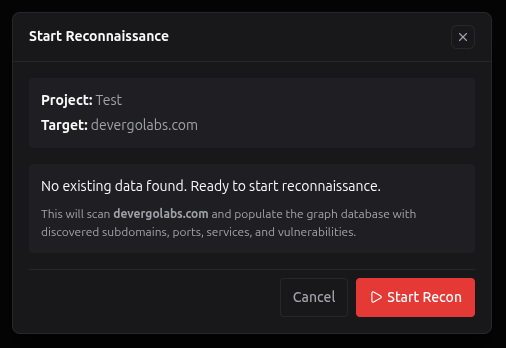
- Click "Confirm" to start the scan
The "Start Recon" button changes to a spinner while the scan is running.
Step 2: Monitor Real-Time Logs
Once the scan starts, a Logs button (terminal icon) appears in the Recon Actions group.
- Click the Logs button to open the Logs Drawer on the right side
- Watch the real-time output as each phase progresses
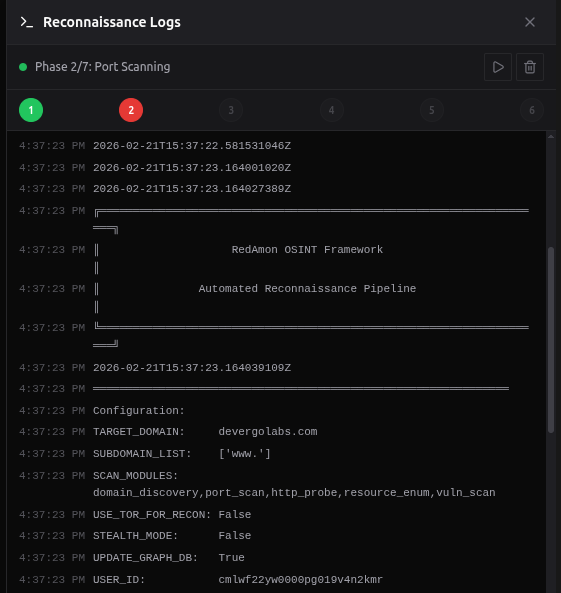
The logs drawer shows:
- Current phase with phase number (e.g., "Phase 3: HTTP Probing")
- Log messages streaming in real-time as the scan progresses
- A Clear button to reset the log display
Step 3: Watch the Graph Build
While the reconnaissance runs, the graph canvas auto-refreshes every 5 seconds. You'll see nodes appearing and connecting in real-time:
- First, Domain and Subdomain nodes appear (GROUP 1 -- parallel: WHOIS + 5 discovery tools + URLScan)
- Then IP nodes connect to subdomains (GROUP 1 -- DNS with 20 parallel workers)
- ExternalDomain nodes appear from URLScan enrichment (GROUP 1)
- New Subdomain, IP, Port, and Endpoint nodes appear from multi-engine search (GROUP 2b -- Uncover queries up to 13 search engines)
- Port nodes attach to IPs, Shodan enrichment data merges in (GROUP 3 -- parallel: Naabu + Shodan)
- Threat intelligence properties populate on IP and Domain nodes -- OTX pulse data, VirusTotal reputation scores, Censys service data, FOFA/ZoomEye/Netlas/CriminalIP host intelligence (GROUP 3b -- 7 tools parallel)
- Port nodes get enriched with product/version/CPE, Technology and Vulnerability nodes appear from NSE scripts (GROUP 3.5 — Nmap service detection)
- BaseURL, Service, and Technology nodes appear (GROUP 4 — HTTP Probe)
- Endpoint and Parameter nodes branch out (GROUP 5 -- parallel: Katana + Hakrawler + GAU + Kiterunner, then jsluice + FFuf + ZAP Ajax Spider + Arjun)
- Secret, Endpoint, and JsReconFinding nodes appear from JavaScript analysis (GROUP 5b -- JS Recon: 6 modules parallel)
- Vulnerability and CVE nodes connect to affected resources (GROUP 6 Phase A -- Nuclei || GraphQL Security || Subdomain Takeover || VHost & SNI || Web Cache Poisoning run in parallel; Phase B -- MITRE enrichment)
- GraphQL Endpoint capability flags (
graphql_graphiql_exposed,graphql_tracing_enabled,graphql_get_allowed, etc.) populate on Endpoint nodes discovered as GraphQL services
Step 4: Download Results
When the scan completes:
- The spinner stops and the "Start Recon" button reappears
- A Download button (download icon) appears in the Recon Actions group
- Click it to download the complete results as a JSON file (
recon_{projectId}.json)
Pipeline Architecture (Fan-Out / Fan-In)
The pipeline is organized into execution groups. Modules within each group run concurrently; groups execute sequentially because later groups depend on earlier results. Graph DB updates run in a dedicated background thread so the main pipeline is never blocked.
| Settings Tab | Phase | Tools | Type | Execution |
|---|---|---|---|---|
| Discovery & OSINT | Subdomain Discovery | crt.sh, HackerTarget, Subfinder, Amass, Knockpy | Passive* | 5 tools parallel |
| Wildcard Filtering | Puredns | Active | Sequential | |
| WHOIS + URLScan | python-whois, URLScan.io API | Passive | Parallel | |
| DNS Resolution | dnspython | Passive | 20 parallel workers | |
| OSINT Enrichment | Shodan / InternetDB | Passive | Parallel with port scan | |
| Uncover Expansion | ProjectDiscovery Uncover (13 engines) | Passive | Before port scan (GROUP 2b) | |
| Threat Intel Enrichment | Censys, FOFA, OTX (AlienVault), Netlas, VirusTotal, ZoomEye, CriminalIP | Passive | 7 tools parallel (GROUP 3b) | |
| Port Scanning | Port Scanning | Masscan, Naabu | Active / Passive | Both parallel (Naabu supports passive InternetDB mode) |
| Nmap Service Detection | Service Version Detection | Nmap (-sV, --script vuln) | Active | Sequential per target |
| HTTP Probing | HTTP Probing | httpx | Active | Internal parallel |
| Tech Detection | Wappalyzer | Passive | Sequential (post-probe) | |
| Banner Grabbing | Custom (Python sockets: SSH, FTP, SMTP, MySQL, etc.) | Active | Parallel workers | |
| Resource Enum | Web Crawling | Katana, Hakrawler | Active | Parallel |
| Archive Discovery | GAU (Wayback, CommonCrawl, OTX) | Passive | Parallel with crawlers | |
| Parameter Mining | ParamSpider (Wayback CDX) | Passive | Parallel with crawlers | |
| JS Analysis | jsluice | Active | Sequential (post-crawl) | |
| Directory Fuzzing | FFuf | Active | Sequential (post-jsluice) | |
| Browser Crawling | ZAP Ajax Spider | Active | Sequential (post-FFuf), per-seed Docker containers in parallel | |
| Parameter Discovery | Arjun | Active / Passive | Methods parallel (GET/POST/JSON/XML) | |
| API Discovery | Kiterunner | Active | Sequential per wordlist | |
| JS Reconnaissance | JS Recon | 90+ secret patterns, source map discovery, dependency confusion, endpoint extraction, DOM sinks, framework detection | Passive | 6 modules parallel (GROUP 5b) |
| Vulnerability Scanning | Vulnerability Scanning | Nuclei (9,000+ templates + DAST + custom template upload) | Active | Parallel with GraphQL + Subdomain Takeover + VHost & SNI (GROUP 6 Phase A) |
| GraphQL Security | GraphQL Security Testing | Endpoint discovery, introspection test, schema extraction, sensitive-field detection, graphql-cop 12 misconfig checks | Active / Passive | Parallel with Nuclei + Subdomain Takeover + VHost & SNI (GROUP 6 Phase A) |
| Subdomain Takeover | Subdomain Takeover Detection | Subjack + Nuclei takeover templates + BadDNS sidecar, layered detection across CNAME/NS/MX/TXT/SPF | Active | Parallel with Nuclei + GraphQL + VHost & SNI (GROUP 6 Phase A) |
| VHost & SNI | VHost & SNI Enumeration | Hidden virtual host discovery via L7 (HTTP Host header) + L4 (TLS SNI) probes per candidate hostname; reveals reverse-proxy / k8s ingress / Cloudflare routing | Active | Parallel with Nuclei + GraphQL + Subdomain Takeover + Web Cache Poisoning (GROUP 6 Phase A) |
| Web Cache Poisoning | Web Cache Poisoning | WCVS breadth sweep + native 5-phase confirmation (cache oracle, isolated cache-buster, framework hypotheses, baseline→poison→clean persistence, scoring); reflected + non-reflective detection of cache poisoning & deception | Active | Parallel with Nuclei + GraphQL + Subdomain Takeover + VHost & SNI (GROUP 6 Phase A) |
| Security Checks | Security Checks | WAF bypass, direct IP access, TLS expiry, missing headers, cache-control | Active | Parallel workers |
| CVE & MITRE | CVE Enrichment | NVD API, Vulners API | Passive | Sequential |
| MITRE Enrichment | CWE / CAPEC mapping | Passive | Sequential |
*Amass can run in active mode when configured. Knockpy performs active DNS probing.
Each phase builds on the previous group's output. You can control which modules run via the Scan Modules setting in your project configuration.
Targeting Modes and the Pipeline
The groups below describe the Single Domain pipeline (the default). The other two targeting modes change only where GROUP 1 gets its input:
| Single Domain | IP / CIDR | Domain batch | |
|---|---|---|---|
| GROUP 1 | Subdomain discovery (5 tools in parallel) + DNS (20 workers) + WHOIS + URLScan | CIDR expansion → Reverse DNS (PTR) per IP → IP WHOIS | Filtered DNS + WHOIS on the group's listed hostnames only (no discovery) |
| Graph root | Real Domain node | Mock Domain node (ip-targets.{project_id}) | One real Domain node per group |
| GROUPs 3-6 | Unchanged | Unchanged | Unchanged, run per group |
In IP mode, each target IP is resolved via PTR to discover its hostname. When no PTR record exists, a mock hostname is generated (e.g., 192-168-1-1). The remaining groups (port scan through MITRE enrichment) run identically.
Domain batch runs this same Single-Domain pipeline once per domain group, one group after another, accumulating every group into a single graph and a single version. Subdomain discovery is off for the hostnames you listed, so those are scanned exactly as given. An entry written as a wildcard (*.example.com or *example.com) is the exception: that one domain gets the full subdomain enumeration a Single Domain project runs, and the rest of the list stays literal. See Domain batch below for the full walkthrough.
GROUP 1: Domain Discovery + WHOIS + URLScan (parallel)
Purpose: Map the target's subdomain landscape. All three top-level tasks (WHOIS, discovery, URLScan) run concurrently. Within discovery, all 5 tools run in parallel.
Techniques used (all concurrent):
- Certificate Transparency via crt.sh — finds certificates issued for the domain. When crt.sh gives no answer (an error, a timeout, or paused after repeated failures), the same lookup is sent to crt.name instead. crt.name allows 100 requests per IP per day, so it is asked once per domain per run and stops for the run when that quota is spent. It refuses a domain with too many names (the log says so), and at most the first 50,000 names of an answer are read. Turning crt.sh off turns this fallback off too
- HackerTarget API — passive DNS lookup
- Subfinder — passive subdomain enumeration using 50+ online sources (certificate logs, DNS databases, web archives)
- Amass — OWASP Amass subdomain enumeration using 50+ data sources (certificate logs, DNS databases, web archives, WHOIS). Supports optional active mode (zone transfers, certificate grabs) and DNS brute forcing
- Knockpy — active subdomain brute-forcing (if
useBruteforceForSubdomainsis enabled) - WHOIS Lookup — registrar, dates, contacts, name servers (runs in parallel with discovery)
- URLScan.io — historical scan data, subdomains, IPs, TLS metadata (runs in parallel with discovery)
- DNS Resolution — A, AAAA, MX, NS, TXT, CNAME, SOA records for every discovered subdomain (20 parallel workers)
Output: Domain, Subdomain, IP, and DNSRecord nodes in the graph.
If a specific
subdomainListis configured, the pipeline skips active discovery and only resolves those subdomains (WHOIS + URLScan still run in parallel). In IP mode, this group is replaced by reverse DNS lookups and IP WHOIS — see above.
Shodan enrichment (runs in GROUP 3 alongside port scan):
- Host Lookup — OS, ISP, organization, geolocation, and known vulnerabilities per IP
- Reverse DNS — discover hostnames missed by standard enumeration
- Domain DNS — subdomain enumeration via Shodan's DNS records (paid plan required)
- Passive CVEs — extract known CVEs from host data without active scanning
URLScan.io enrichment (runs in GROUP 1 alongside discovery):
- Queries historical scan data from URLScan.io's Search API
- Discovers subdomains, IP addresses, URL paths, TLS metadata, server technologies, and domain age
- Collects external domains encountered in historical scans for situational awareness
- Works without API key (public results) or with key (higher rate limits)
ExternalDomain nodes: Throughout the pipeline, multiple modules collect out-of-scope domains (URLScan historical data, HTTP probe redirects, Katana/GAU crawling). At the end of the pipeline, these are aggregated, deduplicated, and stored as ExternalDomain nodes linked to the root Domain.
Both modules are independently toggleable in the Discovery & OSINT tab of project settings. If URLScan enrichment runs, the
urlscanprovider is automatically removed from GAU to avoid duplicate data.
GROUP 2b: Uncover Target Expansion (before port scan)
Purpose: Expand the target surface by querying up to 13 search engines via ProjectDiscovery's uncover tool. Runs before Shodan and port scanning so newly discovered assets are processed by all downstream modules.
How it works:
- Builds a
provider-config.yamlwith only engines that have valid API keys - Runs the
projectdiscovery/uncoverDocker container with domain-based and SSL cert queries - Deduplicates results by (IP, port), handles engine quirks (Google URL-in-IP, PublicWWW host-only)
- Filters non-routable and CDN IPs via
ip_filter.py - Merges discovered subdomains into
dns.subdomainsand IPs intometadata.expanded_ips
Engines (only those with configured keys are used):
| Engine | Key Source | Notes |
|---|---|---|
| Shodan | Reuses existing Shodan key | Search-based discovery (different from direct host lookup) |
| Censys | Reuses existing Censys token | Platform API v3 |
| FOFA | Reuses existing FOFA key | |
| ZoomEye | Reuses existing ZoomEye key | |
| Netlas | Reuses existing Netlas key | |
| CriminalIP | Reuses existing CriminalIP key | |
| Quake | Uncover-specific key | 360 Quake cyberspace search |
| Hunter | Uncover-specific key | Qianxin Hunter |
| PublicWWW | Uncover-specific key | Source code search engine |
| HunterHow | Uncover-specific key | hunter.how internet search |
| Uncover-specific key + CX | Google Custom Search JSON API | |
| Onyphe | Uncover-specific key | Cyber defense search engine |
| Driftnet | Uncover-specific key | Port and service discovery |
No extra keys needed if you already have Shodan, Censys, FOFA, etc. configured -- uncover reuses them automatically. The 7 uncover-specific engines are optional extras for broader coverage.
IP filtering: Non-routable IPs (RFC 1918, CGNAT, loopback) and CDN IPs are automatically filtered before results enter the pipeline. This prevents wasting API credits on downstream enrichment of unusable addresses.
Output: Subdomain, IP, Port, and Endpoint nodes in the graph. Discovered hosts are injected into the pipeline so GROUP 3+ modules process them.
GROUP 3: Shodan + Port Scanning (parallel)
Purpose: Discover open ports and enrich IPs with Shodan intelligence. Both tasks run concurrently.
Port Scan (Naabu) capabilities:
- SYN scanning (default) with CONNECT fallback
- Top-N port selection (100, 1000, or custom ranges)
- CDN/WAF detection (Cloudflare, Akamai, AWS CloudFront)
- Passive mode via Shodan InternetDB (no packets sent)
- IANA service name mapping (15,000+ entries)
Output: Port nodes linked to IP nodes. Enriched IP nodes from Shodan (OS, ISP, geolocation, passive CVEs).
GROUP 3b: Threat Intelligence Enrichment (parallel with GROUP 3)
Purpose: Passively enrich discovered IPs and domains with threat intelligence from seven specialized OSINT platforms. All seven tools run concurrently via ThreadPoolExecutor(max_workers=5). This group runs in parallel with GROUP 3 (port scanning) — neither blocks the other.
Tools (all concurrent):
| Tool | Source | Input | Key Intelligence |
|---|---|---|---|
| Censys | Censys Search API v2 | IPs | Open ports, services, TLS certificate chains, geolocation, ASN, OS fingerprint |
| FOFA | FOFA Search API | Domain/IPs | IP:port pairs, HTTP titles, server headers, geolocation, certificate info, protocol details |
| OTX (AlienVault) | OTX Indicators API v1 | IPs, Domains | Threat reputation, malware families, MITRE ATT&CK IDs, passive DNS history, pulse data |
| Netlas | Netlas Responses API | Domain/IPs | Ports, HTTP metadata, geolocation (lat/lon, timezone), TLS certs, DNS records, WHOIS |
| VirusTotal | VirusTotal API v3 | Domains, IPs | Reputation score, AV analysis stats, categories, tags, JARM fingerprint |
| ZoomEye | ZoomEye API | Domain/IPs | Ports, service banners, device/OS, web app fingerprints, geolocation, ASN, SSL info |
| CriminalIP | Criminal IP API v1 | IPs | Risk score, threat tags (VPN/Tor/proxy/C2/scanner), geo, ISP, abuse history |
OTX is enabled by default — it supports anonymous requests (1,000 req/hr) without an API key. All other tools require an API key configured in Global Settings > API Keys.
Rate limiting: Each tool detects HTTP 429 responses and stops further queries for that scan. VirusTotal free-tier users are limited to 4 requests/minute; the pipeline automatically waits 65 seconds and retries on rate limit. CriminalIP retries after 2 seconds.
Key rotation: FOFA, OTX, Netlas, VirusTotal, ZoomEye, and CriminalIP support automatic round-robin key rotation. Configure additional keys in Global Settings to multiply effective rate limits.
Output: Threat intelligence properties added to existing IP and Domain nodes in Neo4j. Data from each tool is stored as properties on the relevant node (no new node types). Results are also included in the recon_domain.json output file under per-tool keys.
GROUP 3.5: Nmap Service Detection (after port scan merge)
Purpose: Deep service version detection and NSE vulnerability script scanning on all discovered open ports. Runs after port_scan merge (Masscan + Naabu results combined) so it only probes ports already confirmed as open.
Capabilities:
- Service version detection (
-sV) -- identifies product name, version, and CPE for services running on open ports (e.g.vsftpd 2.3.4,Apache Tomcat/8.5.19) - NSE vulnerability scripts (
--script vuln) -- runs Nmap Scripting Engine vulnerability checks against discovered services, extracting CVE IDs from script output - Configurable timing -- T1 (Sneaky) through T5 (Insane), with per-host and total timeout controls
- Stealth mode -- automatically reduces timing to T2 (Polite) and disables NSE scripts
Graph enrichment:
- Port nodes enriched with
product,version,cpe,nmap_scannedflag - Technology nodes created from detected services (
(Service)-[:USES_TECHNOLOGY]->(Technology),(Port)-[:HAS_TECHNOLOGY]->(Technology)) - Vulnerability nodes created from NSE findings (
(Vulnerability)-[:AFFECTS]->(Port),(Vulnerability)-[:FOUND_ON]->(Technology)) - CVE nodes created from NSE-detected CVEs (
(Vulnerability)-[:HAS_CVE]->(CVE),(Technology)-[:HAS_KNOWN_CVE]->(CVE))
Output: Enriched Port and Service nodes, new Technology/Vulnerability/CVE nodes from Nmap. Detected service versions also feed into the CVE lookup pipeline (GROUP 6) for NVD/Vulners enrichment.
Only runs when
NMAP_ENABLEDis true and port scan results contain discovered ports. Configure in the Nmap Service Detection tab of project settings.
GROUP 4: HTTP Probing & Technology Detection
Purpose: Determine which services are live and what software they run.
httpx probing:
- Status codes, content types, page titles, server headers
- TLS certificate inspection (subject, issuer, expiry, ciphers, JARM)
- Response times, word counts, line counts
Technology detection (dual engine):
- httpx built-in fingerprinting for major frameworks
- Wappalyzer second pass (6,000+ fingerprints) for CMS plugins, JS libraries, analytics tools
Banner grabbing:
- Raw socket connections for non-HTTP services (SSH, FTP, SMTP, MySQL, Redis)
- Protocol-specific probe strings for version extraction
Output: BaseURL, Service, Technology, Certificate, Header nodes.
GROUP 5: Resource Enumeration (internally parallel + sequential)
Purpose: Discover every reachable endpoint and hidden parameter. Four tools run simultaneously, then jsluice, FFuf, ZAP Ajax Spider, and Arjun run sequentially.
| Tool | Type | Description |
|---|---|---|
| Katana | Active | Web crawler following links to configurable depth, optionally with JavaScript rendering |
| Hakrawler | Active | DOM-aware web crawler via Docker, discovers links and forms |
| GAU | Passive | Queries Wayback Machine, Common Crawl, AlienVault OTX, URLScan.io for historical URLs |
| Kiterunner | Active | API brute-forcer testing REST/GraphQL route wordlists |
| jsluice | Active | JavaScript analysis — downloads and extracts URLs, endpoints, and embedded secrets (AWS keys, API tokens, etc.) from .js files discovered by Katana/Hakrawler |
| FFuf | Active | Directory/endpoint fuzzing using wordlists (SecLists + custom uploads) to discover hidden content |
| ZAP Ajax Spider | Active | Browser-driven crawling via OWASP ZAP — runs headless Firefox to execute JavaScript and capture XHR/fetch endpoints, SPA route changes, cascade-revealed routes, and post-auth surface invisible to static crawlers. Off by default; auto-disabled in stealth mode |
| Arjun | Active / Passive | Hidden HTTP parameter discovery — tests ~25,000 parameter names against discovered endpoints. Multiple methods (GET/POST/JSON/XML) run in parallel |
Katana, Hakrawler, GAU, and Kiterunner run in parallel. Once crawling completes, jsluice analyzes the discovered JavaScript files sequentially, FFuf brute-forces directory paths using wordlists, ZAP Ajax Spider drives a real browser through the discovered endpoints to capture JS-only XHRs and SPA routes (its own per-seed Docker containers run in parallel up to Parallelism), then Arjun discovers hidden parameters on the discovered endpoints (with selected methods running in parallel).
Results are merged, deduplicated, and classified:
- Categories: auth, file_access, api, dynamic, static, admin
- Parameter typing: id, file, search, auth_param
Output: Endpoint, Parameter, and Secret nodes linked to BaseURL nodes.
GROUP 5b: JS Reconnaissance (after resource enumeration)
Purpose: Deep JavaScript analysis to extract secrets, endpoints, dependency confusion risks, source map exposures, DOM XSS sinks, and framework fingerprints from client-side code. Runs whenever JS_RECON_ENABLED is true, independently of resource enumeration. When resource_enum is active, JS Recon analyzes its discovered JS files; when resource_enum is disabled, JS Recon analyzes manually uploaded files only.
How it works:
- Collects all JS URLs discovered by Katana, Hakrawler, ZAP Ajax Spider, GAU, and jsluice in GROUP 5
- Downloads up to 500 JS files concurrently (10 threads), skipping third-party libraries
- Merges with any manually uploaded JS files
- Runs six analysis modules in parallel (4-worker thread pool):
| Module | What It Finds |
|---|---|
| Pattern Scanning | 90+ secret patterns -- cloud credentials, payment keys, auth tokens, infrastructure URLs, info leaks |
| Secret Validation | Live validation of 21 secret types against their APIs (GitHub, Stripe, Slack, AWS, etc.) |
| Source Map Discovery | Exposed .map files via comment parsing, HTTP headers, and path probing |
| Dependency Confusion | Scoped npm packages not registered on public npm -- attacker could register them |
| Endpoint Extraction | REST APIs, GraphQL, WebSocket, router definitions, admin/debug paths, API documentation |
| Framework & Security | Framework detection (12 built-in), DOM XSS sinks (15 patterns), dev comments with sensitive keywords |
- Extracts new in-scope subdomains from discovered endpoints and feeds them back into the pipeline
- Updates Neo4j graph in a background thread
Subdomain feedback loop: JS Recon discovers subdomains embedded in JavaScript code (API base URLs, CDN references, cloud asset URLs) and merges them back into the pipeline's subdomain list. These new subdomains become available for downstream processing.
Output: Secret, Endpoint, and JsReconFinding nodes linked to BaseURL nodes. New subdomains merged into the pipeline.
Full details: See JS Reconnaissance for module details, output structure, API endpoints, and frontend components.
GROUP 5.5: Supply-Chain Recon (after JS Recon)
Purpose: Black-box detection of known-malicious (MAL-) and known-vulnerable (CVE / GHSA) dependencies the live target actually serves. Runs whenever supplyChainReconEnabled is true, immediately after JS Recon (whose downloaded JS and detected technologies it reuses). Off by default.
How it works: it harvests npm package names and versions from JS Recon's source maps, the http_probe technologies, and a retire.js pass; synthesizes a CycloneDX SBOM; and verdicts it offline against the local OSV database (zero egress, no new fetch to the target). Version-bearing packages are verdicted; names harvested without a version are recorded as inventory but flagged unverdictable. An optional GuardDog deep-analysis pass adds suspicious behavioural findings on the OSV-flagged packages.
Output: Package and MalPackageFinding nodes plus Vulnerability{source='osv'}, anchored to the target's BaseURL nodes via DEPENDS_ON. Read them in the Supply-Chain SCA table. Needs the offline OSV database populated once (./redamon.sh supply-chain-sync npm).
Full details: See Supply-Chain Scanning for the three layers, the tools (OSV-Scanner, GuardDog, retire.js), and the standalone Other-Scans variant.
GROUP 5c: AI Surface Recon (after resource enumeration)
Purpose: Confirm and characterize AI/LLM/MCP/vector-DB infrastructure that generic web recon can't see. Runs as Phase 4.5 whenever AI_SURFACE_RECON_ENABLED is true (gated on its own toggle, not SCAN_MODULES), after resource enumeration. It is black-box and benign — it sends a 1-token chat "ping", a standard MCP initialize, OpenAPI GETs, declarative fingerprint probes, and vector-DB health reads. It never jailbreaks, injects, fuzzes, or presents credentials, and treats a 401 as a positive signal.
How it works:
- Gathers candidate hosts (crawled AI endpoints + http_probe AI flags + AI/vector-DB ports), drops RoE-excluded hosts
- Fans candidates across a thread pool (hosts in parallel, workloads sequential per host); runs seven workloads:
| # | Workload | Confirms / extracts |
|---|---|---|
| 1 | Chat-shape probe + latency | LLM chat endpoint, dialect, streaming, p50 latency |
| 2 | MCP handshake + tools/list + YARA | MCP server, tools, capabilities, tool-poisoning findings |
| 3 | OpenAPI / manifest / model listing | tool/vision/streaming support, model ids + family, cached spec |
| 4 | Julius probe pack (YAML) | confirmed AI Technology (vLLM, Ollama, …) |
| 5 | Vector-DB confirmation reads | qdrant / chroma / weaviate / milvus, unauthenticated read exposure |
| 6 / 7 | latency baseline + summary glue | counters, merged model family |
- Updates the Neo4j graph in a background thread (annotates
Endpoint/Parameter/Technology, adds MCP tool-poisoningVulnerabilitynodes)
Output: combined_result["ai_surface_recon"]; graph enrichment via update_graph_from_ai_surface_recon.
Full details: See Adversarial AI Recon.
GROUP 6 Phase A: Nuclei + GraphQL Security + Subdomain Takeover + VHost & SNI + Web Cache Poisoning (parallel)
Purpose: Test discovered endpoints for security vulnerabilities and uncover hidden infrastructure. All five scanners read from the same combined_result dict (each pulls a different slice - BaseURL/Endpoint/Technology for Nuclei + GraphQL + Web Cache Poisoning, Subdomain/DNS/alive URLs for Takeover, IP/Port/SAN list for VHost & SNI) and write Vulnerability nodes, but have zero data dependency on each other - so they run concurrently via ThreadPoolExecutor using _isolated wrappers that deep-copy the shared result dict to avoid race conditions. Wall-time is dominated by Nuclei (5-30 min) and Web Cache Poisoning (WCVS is thorough and slow - hundreds of requests/URL, 1800 s default budget); the other three complete within minutes (Takeover) or seconds (VHost & SNI).
Nuclei capabilities:
- 9,000+ community templates for known CVEs, misconfigurations, exposed panels
- DAST mode — active fuzzing with XSS, SQLi, RCE, LFI, SSRF, SSTI payloads
- Severity filtering — scan for critical, high, medium, and/or low findings
- Interactsh — out-of-band detection for blind vulnerabilities
- CVE enrichment — cross-references findings against NVD for CVSS scores
30+ custom security checks (configurable individually):
- Direct IP access, missing security headers (CSP, HSTS, etc.)
- TLS certificate expiry, DNS security (SPF, DMARC, DNSSEC, zone transfer)
- Open services (Redis no-auth, Kubernetes API, SMTP open relay)
- Insecure form actions, missing rate limiting
GraphQL security scanner capabilities:
- Endpoint auto-discovery — merges user-specified endpoints with candidates from HTTP probe, resource enumeration, JS Recon, and pattern probing (
/graphql,/api/graphql,/v1/graphql,/v2/graphqlas primary patterns;/query,/gql,/graphiql,/playgroundas secondary patterns only on bases with existing GraphQL evidence) - Introspection test — probes each endpoint for exposed
__schema/__type, extracts the full schema at a configurable TypeRef recursion depth (1-20), counts queries/mutations/subscriptions, and computes a schema hash for change detection - Sensitive-field detection — flags schema fields matching
password,token,secret,key,api,private,credential,auth,ssn,credit,card,cvv,salary,medical, etc. - graphql-cop (opt-in Docker-in-Docker) — runs
dolevf/graphql-cop:1.14for 12 additional checks: alias overloading, batch query DoS, directive overloading, circular introspection DoS, GraphiQL/Playground detection, trace mode, GET-based queries/mutations, POST url-encoded CSRF, field suggestions, unhandled error leakage - 5 authentication modes — Bearer, Cookie, custom header, Basic (base64), API key
- Rate limiting + retries — global RPS cap (0-100), retry with exponential backoff on
429/5xx, configurable concurrency (1-20) - RoE enforcement — out-of-scope endpoints (wildcards supported) are skipped and counted in
endpoints_skipped - Endpoint capability flags — booleans like
graphql_graphiql_exposed,graphql_tracing_enabled,graphql_get_allowed,graphql_batching_enabledare persisted on the Endpoint node even for negative results
Web Cache Poisoning scanner capabilities:
- Two-engine detection - the third-party WCVS (Hackmanit, Docker-in-Docker) sweeps 10+ technique classes for breadth ("find suspects"), then a RedAmon-native 5-phase confirmation engine re-proves every suspect with a safe baseline→poison→clean→persistence sequence ("prove it")
- Cache oracle - confirms a URL is actually served through a cache via
X-Cache/CF-Cache-Status/Age/Viaheaders, with a behavioural fallback (frozen-Date probe) for silent caches that emit no cache headers; non-cacheable URLs are skipped - Isolated, benign testing - every test mints a unique cache-buster so it lands in its own slot and never poisons the real page; payloads are non-resolving
.invalidcanaries, never live XSS or real domains - Native hypotheses - generic unkeyed-header families (
X-Forwarded-Host,X-Forwarded-Proto,X-Forwarded-For, URL-override, …) plus fingerprint-gated framework packs for Next.js / Nuxt / Remix - Reflected + non-reflective detection - confirms both an echoed canary and a persisted behavioural change (status flip,
Locationredirect, body diff), the latter guarded against false positives by requiring stability across two clean baselines - Confidence scoring - findings are tiered Confirmed / Strong / Tentative / Rejected; only those at or above the
Min confidencegate (default 0.8) becomeVulnerability {source:'cache_poisoning'}nodes
Output: Vulnerability and CVE nodes linked to Endpoints and Parameters. GraphQL adds: introspection findings (with sensitive field lists), graphql-cop misconfiguration findings, and capability flags on the Endpoint nodes. Web Cache Poisoning adds: scored cache_poisoning Vulnerability nodes carrying the unkeyed vector, cache signals, impact, and a clickable PoC link + curl verification command.
Stealth mode overrides (GraphQL): rate limit forced to 2/s, concurrency to 1 (sequential), timeout to 60s, and the four DoS-class graphql-cop tests (alias overloading, batch query, directive overloading, circular introspection) are forced off.
Stealth mode (Web Cache Poisoning): the module is disabled entirely - active poisoning probes are loud and high-volume, incompatible with stealth. CPDoS stays force-off regardless.
GROUP 6 Phase B: MITRE Enrichment
MITRE Enrichment (runs automatically after Phase A completes — depends on Nuclei CVEs):
- Maps every CVE to its corresponding CWE weakness and CAPEC attack patterns
- Uses the CVE2CAPEC repository (auto-updated with 24-hour cache TTL)
- Provides attack pattern classification for every vulnerability found
Additional MITRE output: MitreData (CWE) and Capec nodes linked to CVE nodes.
Domain batch: scanning many domains in one run
A project set to Domain batch targets a list of hostnames spanning several domains instead of a single target. RedAmon groups the list by domain and scans the groups one after another.
How the list is grouped
The domain is the last two labels of a hostname. So suba.sub3.domain3.com
belongs to domain3.com with the prefix suba.sub3.
| You paste | Group | Domain | Hosts |
|---|---|---|---|
sub1.domain1.com | 1 | domain1.com | sub1 |
sub2.domain2.it | 2 | domain2.it | sub2 |
sub3.domain3.com | 3 | domain3.com | sub3, suba.sub3 |
suba.sub3.domain3.com |
This is the same thing you would do by hand in a single-domain project: the domain goes in Target Domain, everything in front of it goes in Subdomain Prefixes. A batch therefore scans exactly as a hand-built project would.
One consequence is worth knowing: foo.example.co.uk groups under co.uk,
because the rule counts labels rather than consulting a public-suffix list. The
project form shows you the computed groups before you save, so you always see
the grouping before it runs.
What happens when you run it
- It is one scan, not many. The batch takes a single row in the Scan queue, one memory reservation and one container. Stop it and the whole batch stops.
- The graph fills in as it goes. The previous recon data is cleared once, at the start. Each group then finishes its whole pipeline and writes to the graph before the next one begins, so every group accumulates into one graph.
- You get one new version covering all the domains, exactly as a single-domain scan produces one version. Run it again for a second version.
- Only your hostnames are scanned. Subdomain discovery is off for a batch.
- A failing domain does not stop the rest. Failures are listed at the end.
The recon drawer shows Group 2/3 alongside the usual phase progress, since the
six phases restart for each group.
Limits
500 hostnames and 50 domains per project. Remember that a batch holds the project's single scan slot until every group is done, so a long list is a long scan.
Scan Duration Estimates
Duration varies based on target size, network conditions, and scan settings:
| Target Type | Approximate Duration |
|---|---|
| Small (1-5 subdomains, few ports) | 5-15 minutes |
| Medium (10-50 subdomains) | 15-45 minutes |
| Large (100+ subdomains) | 1-3 hours |
| IP mode (single IP) | 5-10 minutes |
| IP mode (CIDR /24 = 254 hosts) | 30-90 minutes |
Key factors affecting duration:
- Bruteforce for subdomains adds significant time for large domains
- Katana depth > 2 increases crawling time exponentially
- DAST mode doubles vulnerability scanning time
- GAU with verification adds 30-60 seconds per domain
After Reconnaissance
Once the scan is complete, you can:
- Explore the graph — click nodes to inspect their properties, filter by type using the bottom bar
- Switch to Data Table — view all findings in a searchable, sortable table with Excel export
- Run GVM scan — complement web-layer findings with network-level vulnerability testing (see GVM Vulnerability Scanning)
- Run GitHub Hunt — search for leaked secrets (see GitHub Secret Hunting)
- Run the Secret Multiscanner - scan repositories, registries, buckets and CI systems with 1060 secret detectors and live API verification (see Secret Multiscanner)
- Use the AI Agent — ask the agent to analyze findings, identify attack paths, and exploit vulnerabilities (see AI Agent Guide)
- Compare scans over time — with Scan Timeline, diff this scan against a previous version (Recon Delta) to see new ports, new CVEs, and resolved findings, or schedule scans to run automatically
Next Steps
- GVM Vulnerability Scanning — add network-level vulnerability testing
- AI Agent Guide — let the AI analyze and act on your findings
- AI in the Recon Pipeline — let the LLM sharpen individual scan steps (ffuf extensions, nuclei tags, WAF and takeover calls)
- Scan Timeline — version your graph, diff scans over time, and schedule recurring scans